

Hardware Robot Vector Free icon download
Download all to grab every PNG variant.
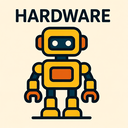
The icon under description is a meticulously crafted digital artwork that seamlessly integrates the core concepts of Hardware, Robot, and Vector. At first glance, it appears as a sleek and modern symbol representing the intersection of physical engineering, artificial intelligence, and digital precision. This icon is not merely decorative; it serves as a visual manifesto for the convergence of mechanical innovation and computational intelligence in contemporary technology.
At its foundation lies the concept of Hardware. The icon’s structure is built upon tangible, real-world engineering principles. It features angular, geometric shapes that mimic the structural components found in industrial machinery—think metal frames, circuit boards, and articulated joints. The color palette leans toward metallic grays and steel blues with subtle gradients to suggest reflective surfaces and mechanical durability. These tones convey robustness and reliability—hallmarks of high-performance hardware systems designed for longevity under demanding conditions.
The central figure of the icon is a stylized Robot, rendered with a balance between abstraction and anthropomorphism. It possesses a humanoid silhouette, but its form is abstracted to emphasize function over realism. The head is simplified into a smooth, rounded dome with two glowing optical sensors—representing vision systems or AI-driven perception modules. Its torso is segmented with visible joints and hinges, suggesting mobility and adaptability. Arms extend symmetrically from the body, each ending in multifunctional manipulators: one with gripper-like appendages for precision handling, the other equipped with tool-like projections that hint at versatility in execution.
What sets this robot apart is its integration of digital elements into its mechanical form. Instead of traditional limbs or motors, the icon's limbs are composed of interconnected nodes and lines resembling circuitry. These pathways pulse faintly with a soft blue light, symbolizing active data flow and internal processing power. This visual metaphor bridges the gap between physical mechanics and computational intelligence—highlighting that modern robotics is not just about metal and motion but also about software-driven cognition.
As a Vector icon, its design adheres to strict principles of scalable precision. The entire composition is built using mathematical paths, curves, and shapes rather than pixels. This ensures that the icon maintains crisp clarity and sharp detail at any size—whether displayed on a smartphone screen or rendered in large-format signage for industrial exhibitions. Each element is precisely positioned using vector tools like anchor points and Bezier curves to achieve smooth transitions between parts. The lines are clean, unbroken, and consistent in stroke width, demonstrating the hallmark of professional vector illustration.
One particularly striking feature is the use of negative space to suggest movement and purpose. The robot appears poised mid-stride or in a dynamic pose, with its weight shifting forward slightly. This is achieved not through additional graphic elements but through thoughtful composition—shifting shadows, implied motion blur (represented via tapered lines), and strategic gaps between limbs that suggest momentum. All of these effects are vector-based and remain consistent across different resolutions.
The background of the icon is often minimal or transparent, allowing the hardware-robot to stand out as a self-contained emblem. In some variations, a subtle grid pattern is integrated beneath the robot’s base—this serves as a nod to both digital design (a common vector canvas feature) and engineering schematics (representing blueprint precision). The grid reinforces the idea that this robot isn't just built; it's designed with mathematical rigor and structural planning.
From a technical perspective, every shape within the icon is scalable. Whether viewed at 16x16 pixels or 2048x2048 pixels, no blurring occurs—thanks to the vector nature of its construction. This makes it ideal for use across diverse platforms: embedded systems interfaces, robotic control dashboards, tech conference branding, or industrial automation software. The icon’s adaptability ensures that it communicates effectively in both high-density and low-resolution environments.
Functionally, this icon serves multiple purposes. In a hardware engineering context, it symbolizes the next generation of smart machines—devices that are not only mechanically capable but also intelligent, adaptive, and networked. In robotics development teams, it acts as a visual shorthand for collaborative innovation between mechanical engineers and AI researchers. And in digital design workflows, it exemplifies best practices in vector illustration: clean lines, semantic structure, scalability without loss of quality.
In essence, the icon is more than just a representation—it’s an embodiment of modern technological evolution. It captures the synergy between physical construction (Hardware), sentient machines (Robot), and flawless digital craftsmanship (Vector). It is both a metaphor and a map: a visual guide to what’s possible when engineering meets intelligence, all delivered through the precision of vector design.
Create your own icon with our GoGPT AI prompt:
GoGPT