

Hardware Satellite Metallic Free icon download
Download all to grab every PNG variant.
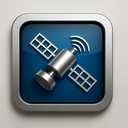
The icon in question is a masterclass in design philosophy—where the cold precision of engineered hardware converges seamlessly with the advanced technology embodied by modern satellite systems. Crafted with meticulous attention to detail, this icon stands as a visual testament to human innovation and the relentless pursuit of connectivity across vast distances. The central theme revolves around three defining attributes: Hardware, Satellite, and Metallic. Each element is not just represented—it is elevated into a symbolic form that communicates complexity, durability, and technological advancement.
At its core, the icon is rooted in the principles of industrial hardware design. The structure exhibits sharp edges, geometric symmetry, and a mechanical precision that suggests high-grade manufacturing. Every curve and plane has been calculated with purpose—there are no superfluous elements; each line serves both function and form. This reflects the ethos of modern hardware: minimalism driven by engineering necessity rather than ornamentation.
The icon's base is constructed as a series of interlocking hexagonal segments, reminiscent of gear mechanisms or structural frameworks used in high-performance machinery. These hexagons are not merely decorative—they symbolize strength, efficiency, and the modularity characteristic of advanced hardware systems. The precise alignment and seamless transitions between each segment suggest a level of craftsmanship found in aerospace components or precision robotics.
Further emphasizing the hardware aspect are subtle details such as micro-grooves along the edges, simulated screw heads embedded at strategic junctions, and faint engraved patterns that mimic circuit traces or internal wiring. These elements do not detract from the icon’s visual clarity; instead, they enrich it with a sense of depth and realism. The overall impression is one of something engineered for extreme environments—something built to withstand pressure, temperature variations, and mechanical stress.
While the base exudes grounded industrial strength, the upper portion of the icon ascends into a futuristic satellite configuration. The central element is a spherical module—elevated slightly above the hardware foundation—encased within a rigid, segmented dome structure resembling solar arrays and antenna reflectors. This sphere symbolizes not just orbiting technology but also intelligence in motion.
From the top of this sphere extend three thin, articulated arms—each equipped with small circular nodes that resemble communication antennas or sensor pods. These arms are positioned at 120-degree intervals, forming a stable tripod configuration that evokes the balance and orientation required for satellites to maintain their orbit. The subtle angularity of these limbs conveys both mobility and stability: they suggest the satellite’s ability to adjust its position in space, transmit signals across continents, and receive data from ground stations.
Interspersed along the arms are small hexagonal panels—each representing a functional unit such as a photovoltaic cell or a data transmission module. These panels are slightly recessed into the arm structure, giving them the appearance of being seamlessly integrated rather than affixed. The use of negative space around these modules enhances readability while reinforcing the idea that this is not just an image but a working system in miniature form.
The satellite sphere itself features a subtle gradient from dark gray to deep charcoal, suggesting both its presence in the vacuum of space and its ability to absorb solar radiation efficiently. Embedded within it are three small circular ports—representing sensor lenses or communication apertures—arranged symmetrically to convey omnidirectional awareness.
The defining visual characteristic of the icon is its metallic finish. This is not a flat color or simple gradient—it is a complex, three-dimensional surface treatment that mimics real metal under varying light conditions. The material appears to be polished titanium or aerospace-grade aluminum, known for its strength-to-weight ratio and resistance to corrosion.
The texture includes micro-reflections that shift subtly based on the angle of view, simulating how light interacts with a smooth metallic surface. Highlights are crisp and localized—especially along the edges of hexagons and arm joints—while shadowed areas retain deep contrast, enhancing depth perception. A faint metallic sheen runs across all surfaces, giving the impression that the icon is not just rendered on screen but physically exists in a high-tech laboratory or control room.
Crucially, this metallic quality serves more than aesthetic purposes. It communicates durability—suggesting that the hardware is built to last in harsh environments. The reflective nature also symbolizes clarity and transparency: light passing through or bouncing off the surface represents data flow, signal transmission, and connectivity—all central themes of satellite technology.
In every aspect of its design, this icon embodies the harmonious fusion of Hardware, Satellite, and Metallic. The rigid geometry speaks to the discipline of engineering; the satellite form reflects advanced space technology; and the metallic surface unites them into a cohesive symbol of innovation. It is not merely an icon—it is a narrative in visual form, telling the story of human progress: from ground-based machinery to orbiting intelligence, all forged from materials as enduring as they are elegant.
Whether used in technical software, space exploration dashboards, or industrial design platforms, this icon commands attention and respect. It stands not just as a representation of technology but as an emblem of what is possible when precision meets vision—and when metal becomes more than material: it becomes meaning.
Create your own icon with our GoGPT AI prompt:
GoGPT