

History Train Monochrome Free icon download
Download all to grab every PNG variant.
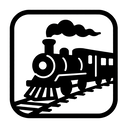
At first glance, this monochrome icon appears to be a simple line drawing—minimalist in form, yet profoundly layered in meaning. Rendered entirely in shades of black and white without any hint of color or gradient, the icon transcends visual appeal to become a symbolic artifact representing the intricate relationship between human progress and historical memory. Central to its composition is an unmistakable image of a train—specifically, a classic steam locomotive from the 19th century—but rendered not as a literal photograph or detailed illustration. Instead, it is stylized into pure geometric elegance: angular lines define the engine’s boiler, smokestacks rise in sharp verticals, and wheels are depicted as perfect circles with evenly spaced spokes. This deliberate simplification enhances its universal recognizability while simultaneously emphasizing its deeper symbolic meaning.
What makes this icon truly remarkable is how it unifies three powerful concepts—History, Train, and Monochrome—into a single, cohesive visual narrative. The train is more than a mere mode of transportation; it is an emblem of industrial revolution, technological ambition, and the relentless march of time. Steam-powered locomotives were not just vehicles that carried goods and people across continents—they were catalysts for social transformation. They dismantled geographical barriers, accelerated communication, reshaped economies, and fundamentally altered how human societies interacted across space and time. In this context, the train becomes a metaphor for historical progression: constant movement forward, unyielding momentum, and irreversible change.
The monochrome nature of the icon amplifies its thematic depth. By eliminating color—those vibrant hues that often signal modernity, emotion, or cultural identity—the design strips away all distractions. It forces the viewer to focus on form, structure, and meaning. This austerity evokes a sense of timelessness; it feels both ancient and enduring. The black-and-white palette recalls old photographs from the archives of history: faded images of early railways taken in the mid-1800s, where every grainy detail tells a story long past but never forgotten. It also echoes archival sketches, newspaper illustrations from bygone eras, and black ink drawings that once documented progress with reverence and precision. In this way, the monochrome aesthetic becomes an active participant in storytelling—it suggests memory preserved in silence.
Moreover, history itself is not merely a series of dates or events but an ongoing journey—one shaped by movement and transformation. The icon’s train does not stop; it continues along its rails into the horizon, suggesting that history is never static. It flows like a river, carrying with it the weight of past decisions, innovations, struggles, and triumphs. Each wheel turn represents another chapter in human development—the telegraph connecting distant nations, the expansion of rail networks enabling mass migration and cultural exchange, the rise of urban centers fueled by efficient transport systems. The train thus becomes a vessel not just for physical travelers but for ideas that move across time: democracy spreading through railways into remote regions, industrialization transforming agrarian societies, technological breakthroughs accelerating global integration.
Even the smallest design elements contribute to this historical narrative. The smoke curling from the stack is not rendered with realism but as a stylized wave—a continuous line that suggests both motion and continuity. It does not dissipate into emptiness but stretches toward the far edge of the icon’s frame, implying that legacy persists beyond immediate visibility. Similarly, the track lines are parallel and unbroken, running straight into the distance without curves or deviations—symbolizing linear progress, order in chaos, and a belief in forward movement even when challenges arise. The wheels themselves are perfect circles: symbols of eternity and cyclical time. In this paradoxical duality—the train moving forward while its wheels rotate endlessly—the icon captures the essence of history itself: a dynamic force that evolves while maintaining continuity with the past.
From an artistic standpoint, the monochrome approach elevates this icon beyond utilitarian design. It transforms it into a piece of visual poetry—simple yet profound, restrained yet expressive. The absence of color is not limitation but liberation; it allows space for interpretation and emotional resonance. Viewers may see in the train the promise of future exploration, or they may sense the melancholy of forgotten routes and abandoned stations. The icon becomes a mirror reflecting individual perspectives on time: nostalgia for what was lost, awe at what has been achieved, or cautious optimism about what lies ahead.
In conclusion, this monochrome icon is not merely a representation of a train or an abstraction of history—it is an immersive experience in symbolic design. Through its deliberate minimalism, timeless aesthetic, and layered metaphorical content, it encapsulates the profound truth that history is movement; that progress requires momentum; and that even in silence—especially in silence—legacies endure. As a visual artifact, it stands as a testament to the enduring power of ideas conveyed through form: where every line speaks of time, every curve remembers the past, and every black-and-white stroke carries the weight of human journey.
Create your own icon with our GoGPT AI prompt:
GoGPT