

Internet Bus 3D isometric Free icon download
Download all to grab every PNG variant.
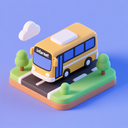
In a world where digital connectivity and urban transportation converge, this meticulously crafted 3D isometric icon embodies the seamless fusion of Internet and modern public transit through the symbolic form of a Bus. The result is not merely an image, but a dynamic visual metaphor representing how real-time data flows through city streets, connecting people on the move with information, services, and each other. This icon stands as a masterpiece of digital artistry — blending spatial depth, modern design language, and conceptual richness into a single compelling graphic.
The foundation of the icon lies in its 3D isometric projection, which grants it an immersive sense of depth and realism while maintaining the clarity and precision characteristic of technical illustrations. Viewed from a 30-degree angled perspective, the bus appears to float just above a stylized city grid, rendered with subtle gradients and shadow layers to simulate physical presence. The use of isometric design ensures that all elements — from the vehicle's structure to its digital components — are proportionally consistent and spatially coherent, giving viewers an intuitive understanding of the icon’s three-dimensional nature without relying on traditional perspective cues.
At first glance, the bus takes center stage as a sleek, modern electric transit vehicle with rounded contours and a clean aesthetic. Its body is painted in a vibrant gradient of blue and silver — colors that symbolize innovation, technology, and sustainability. The front features large digital LED panels displaying real-time information such as route numbers (e.g., "Line 7"), destination names ("Downtown Hub"), and dynamic icons indicating upcoming stops. These displays are not mere decorations; they are integral to the icon’s narrative of Internet integration, showcasing how smart infrastructure keeps passengers informed and connected.
What truly sets this icon apart is how seamlessly it incorporates digital elements into the physical form of the bus. Along its sides, transparent "data pipes" — glowing blue pathways made of segmented light beams — wrap around the vehicle like neural networks. These are not literal conduits but symbolic representations of wireless connectivity: Wi-Fi signals, 5G towers, and cloud-based communication systems that keep passengers online during their journey. The data streams pulse gently in rhythm with a subtle animation loop (if interactive), suggesting real-time activity and live internet access.
At the roof of the bus, an array of small antennae and sensors extends upward like futuristic spines. These are not only decorative but represent the vehicle’s role as a mobile node in a citywide IoT (Internet of Things) ecosystem. Each antenna connects to invisible networks, transmitting GPS location data, passenger counts, traffic updates, and even environmental readings back to central control systems — all powered by Internet infrastructure. In this way, the bus is not just transporting people; it’s actively collecting and sharing data that enhances urban mobility and smart city planning.
Inside the bus’s windows — rendered with transparent glass textures and depth-shaded interiors — passengers are subtly implied through stylized silhouettes using minimalist figures, each holding smartphones or tablets. Their screens glow faintly, showing maps, social media feeds, or video calls. This visual narrative reinforces the core idea: that modern commuting is inseparable from digital engagement. The Internet isn’t just present; it’s embedded in every aspect of the journey.
The base of the icon features a stylized urban landscape beneath the bus — a grid of streets, crosswalks, and buildings rendered in simplified but recognizable form. These elements are drawn with consistent isometric scaling, creating a sense that the bus travels through an actual city environment. Some intersections feature small icons representing transportation hubs: train stations, bike-sharing docks, and pedestrian zones — all connected by dotted lines to symbolize integrated transit networks enabled by digital coordination.
Color theory plays a crucial role in reinforcing the icon’s theme. The dominant palette combines cool tones (blues and cyans) for technology and connectivity, contrasted with warm highlights (amber yellows) from dashboard lights and streetlamps to suggest human activity. This balance ensures visual harmony while subtly guiding the eye toward key features: digital interfaces, data flow lines, and the central bus body.
When used in UI/UX contexts — such as apps for public transit, smart city dashboards, or digital navigation tools — this icon functions not just as a symbol but as a storytelling device. It conveys complex ideas in an instant: real-time information access on the move, sustainable urban mobility, and the invisible web of Internet infrastructure that powers modern life. The 3D isometric style enhances its appeal across digital platforms, making it highly legible at small sizes while maintaining visual richness.
In essence, this 3D isometric icon transcends conventional design. It transforms the humble bus into a beacon of digital integration — a moving node in an ever-expanding web of connection. Where once only mechanical systems drove progress, today’s transit vehicles are powered by data. This icon captures that evolution perfectly: it is both a machine and a network, both physical and virtual, simultaneously grounded in urban reality and soaring through the digital sky.
Create your own icon with our GoGPT AI prompt:
GoGPT