

Internet Credit card Pixel art Free icon download
Download all to grab every PNG variant.
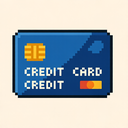
The icon described here is a meticulously crafted pixel art masterpiece that seamlessly integrates three core digital elements: the Internet, the Credit card, and the aesthetic language of classic 8-bit video games. This small yet powerful visual symbol—measuring just 32x32 pixels—serves as a nostalgic yet forward-thinking emblem representing secure online transactions in a digital age that values both technological innovation and retro charm.
At first glance, the icon captures the essence of connectivity through its central motif: a stylized globe rendered in crisp pixel form. This globe is not merely an abstract representation but an evolution of early internet icons from 1980s and 1990s software interfaces. Each pixel is carefully placed to suggest a networked world—its surface glowing with soft, interconnected lines that resemble data streams and signal waves, reminiscent of the old-school “web” or “network” graphics used in early dial-up modems. These lines radiate outward from the globe’s equator like concentric rings of digital energy, symbolizing global reach and instantaneous communication—an essential trait of today's internet infrastructure.
Overlaying this pixelated globe is a credit card, artfully integrated into the composition with both subtlety and purpose. The card itself is drawn in 8-bit style: flat colors with hard edges, minimal gradients, and blocky details that harken back to classic arcade games or DOS-era software graphics. The front of the credit card features a clean rectangle made of bold white pixels on a dark blue background—a stark contrast typical of pixel art. Within this space, the card’s essential elements are distilled into their most basic forms: a simple logo (perhaps resembling Visa or Mastercard’s iconic emblem but simplified into just 4–5 pixels), and four rows of pixelated numbers—each digit meticulously crafted to be legible despite its minimal size.
What makes this design particularly compelling is how the credit card appears to emerge from within the globe itself. The lower portion of the card is seamlessly fused with the globe’s surface, suggesting that financial transactions are an intrinsic part of internet culture. This fusion visualizes a modern truth: that our global digital network isn't just for communication and information—it's also a vast, complex marketplace where millions of credit card payments occur every second. The pixel-perfect alignment between card and globe reinforces the idea that online finance is not an add-on feature but a fundamental layer of internet functionality.
The color palette is deliberately limited to eight distinct shades: black (#000), dark blue (#0A2B5D), electric blue (#39C7FF), white (#FFF), bright yellow-orange (#F4D35E), red-orange (#E64A19), grayish green (for the card's magnetic stripe, #5C886F) and a subtle highlight color used for depth (a pale cyan, #B0F0FF). This restricted gamut is characteristic of true pixel art, where every color must carry weight. The use of electric blue for data lines and highlights gives the icon a futuristic yet retro feel—like it was pulled from an old-school game about digital banking or internet security.
Even in such a small format, intricate details are preserved. For example, the corners of the credit card are slightly rounded using just 2–3 pixels each—achieving softness within a grid-based system. The magnetic stripe at the bottom is rendered as a series of vertical black and white pixels arranged in a checkerboard pattern that mimics actual magnetic strips, adding authenticity. Tiny pixelated "microchip" graphics—commonly seen on modern cards—are represented as small rectangles near the card’s top-left corner, composed of just five pixels each.
Security is subtly implied through design choices. The globe emits a faint glow around its edges—a digital aura that suggests encryption and protection. This visual cue aligns with user trust in secure online transactions: while the icon celebrates commerce, it never sacrifices safety. The combination of pixel art's nostalgic innocence with the modern concept of online finance creates an intriguing paradox: something familiar yet cutting-edge, simple yet deeply significant.
Functionally, this icon would be ideal for use in digital wallets, e-commerce platforms, mobile apps dealing with online payments, or even as a branding element for fintech startups that pride themselves on blending old-school charm with modern security. It could serve as a favicon for secure payment portals or appear alongside transaction confirmation screens—where its playful yet professional aesthetic reassures users that their data and finances are in safe hands.
In conclusion, this 32x32 pixel artwork is more than just a visual symbol; it is a cultural artifact that speaks to the convergence of three powerful forces: the boundless reach of the Internet, the universal currency of the Credit card, and the enduring artistry of Pixel art. It honors technological progress while paying homage to digital history. With every pixel meticulously placed, it becomes a tiny but potent reminder that even in our hyper-connected, fast-paced digital world, beauty can still be found in simplicity—and trust can be built through style.
Create your own icon with our GoGPT AI prompt:
GoGPT