

Internet Drone Steampunk Free icon download
Download all to grab every PNG variant.
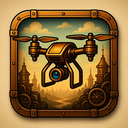
The icon titled "The Aethernet Drift" is a meticulously crafted fusion of three seemingly disparate realms—digital connectivity, autonomous aerial mobility, and retro-futuristic industrial aesthetics. At first glance, it appears to be an intricate brass-and-iron artifact from an alternate Victorian age where the Internet wasn’t born from silicon chips but from enchanted gears and steam-powered neural networks. Yet beneath its ornate surface lies a profound narrative about the evolution of communication, surveillance, and autonomous intelligence in a world where technology breathes with both mechanical precision and digital consciousness.
The central element of the icon is a towering, spherical drone—resembling an airship’s command sphere suspended mid-air by invisible forces. This drone is not made from sleek carbon fiber or matte aluminum but instead constructed from layered brass plates, riveted steel frames, and copper tubing that coil like vines around its core. Its outer shell bears the marks of centuries-old wear: faint etchings of Morse code patterns, faded symbols representing early network protocols (like TCP/IP rendered in Gothic script), and tiny porthole windows glowing with a soft amber light—each a portal into a microcosm of digital data streams.
What sets this drone apart is its integration with the Internet. Instead of traditional Wi-Fi signals represented by abstract waves, the icon visualizes connectivity as an intricate web woven through space. Delicate filaments made of glowing copper wire spiral outward from the drone's core, forming a vast network that stretches into the horizon. These filaments pulse with rhythmic light—blue for data transfer, gold for secure transmissions—mirroring real-time network activity. Embedded within them are microscopic brass nodes shaped like old-fashioned telegraph relays, each labeled with archaic domain extensions such as “.steam” or “.clockwork.” The network doesn’t just connect devices—it appears to be alive, breathing in sync with the drone’s internal mechanisms.
At the base of the drone, a complex steam engine drives its flight and data processing systems. The engine is visible through an open panel, revealing a labyrinth of interlocking pistons, gear trains, and pressure gauges. A thick brass pipe emits rhythmic bursts of steam that spiral upward in elegant spirals before dissipating into the atmosphere—each puff carrying a digital signature: fleeting strings of binary code or encrypted glyphs that vanish like smoke. The engine’s power source is not coal or oil but a central core—a glowing crystal resembling a fossilized data packet, pulsing with energy harvested from the ambient electromagnetic field of the world itself.
The Steampunk aesthetic dominates every detail. Gears of varying sizes rotate slowly around the drone’s perimeter, some turning clockwise and others counter-clockwise as if in perpetual tension—a nod to Newtonian mechanics clashing with quantum computation. Exposed pipes carry not water or steam but shimmering streams of liquid light—data in motion, flowing like molten gold through a system of valves and pressure regulators. The drone's "eyes" are twin brass lenses mounted on articulated arms, resembling giant spyglasses from the 1800s, yet they flicker with holographic displays showing real-time network maps and sensor feeds.
Surrounding the central drone are four smaller mechanical appendages—each a functional drone unit in its own right. These micro-drones resemble antique watch components: miniature gears orbiting tiny motors, brass wings that flap in sync with data bursts. They serve as relay nodes, scanning for signal anomalies or detecting cyber intrusions by listening to electromagnetic frequencies through antennae shaped like tuning forks. One carries a stylized scroll held by a mechanical hand—symbolizing the archival function of the Internet; another holds an inkwell and quill that etch digital footprints onto brass tablets, representing data logging in a pre-digital age.
Even the background is meaningful. Instead of empty space or solid color, it depicts a panoramic view of a skyborne metropolis: towering clockwork towers with steam-chimneys belching coded vapor; bridges made of glowing copper cables connecting airships to observatories; and floating libraries where books are bound in circuit-board leather. This cityscape is not merely decorative—it is the physical manifestation of the Internet as a living, breathing ecosystem: a cybernetic civilization that runs on steam-powered servers, cloud storage stored in weather balloons filled with etheric data particles, and digital communication maintained by airborne couriers—drone pigeons adorned with tiny brass transmitters.
The overall color palette is rich and warm: burnished golds, deep coppers, gunmetal grays, and occasional flashes of electric blue or emerald green where the digital elements intersect with the mechanical. Every line is deliberate—every curve purposeful. The icon doesn’t just represent technology; it embodies a philosophy: that innovation need not be cold or sterile but can be crafted with artistry, history, and wonder.
In essence, "The Aethernet Drift" is more than an icon—it’s a manifesto. It unites the relentless progress of the Internet, the silent autonomy of the Drone, and the tactile grandeur of Steampunk. It tells a story not just about what technology can do, but about how it should feel—like a machine built by dreamers, powered by imagination, and connected through invisible threads that span time, space, and the boundless digital frontier.
Create your own icon with our GoGPT AI prompt:
GoGPT