

Internet Flower Steampunk Free icon download
Download all to grab every PNG variant.
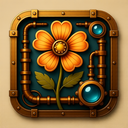
In the intricate tapestry of digital symbolism, few icons encapsulate such a rare and poetic convergence as "The Steam Blossom"—a masterful fusion of Internet, Flower, and Steampunk. This icon stands as a visual ode to the harmony between nature’s grace and the mechanical precision of an alternate Victorian age, where data flows like steam through brass arteries, and blossoms bloom not in soil but within glowing network nodes. At first glance, it appears to be a fantastical hybrid—a delicate flower forged from gears and rivets—but upon closer inspection, its layers reveal a deeper narrative about connectivity, growth, and the elegance of interwoven systems.
The central figure of the icon is a large, stylized flower, not one rooted in earth but suspended in mid-air as if emerging from an intricate mechanical apparatus. The petals are crafted from thin sheets of aged brass and copper, each delicately etched with swirling patterns resembling both circuit boards and botanical veins. The outermost petals curl outward like the arms of a mechanical fan, subtly suggesting motion and energy—perhaps even the gentle hum of data transmission. Their surfaces are weathered to a soft patina, as if having journeyed through decades of steam-powered computation.
At the heart of this floral mechanism lies a radiant core resembling a glowing glass sphere—a metaphor for both the digital brain and a seed pod. This central orb pulses with an ethereal blue light, reminiscent of fiber-optic cables or server-lit data centers, pulsating rhythmically like a heartbeat. Inside it, fractal-like patterns swirl: tiny binary sequences blend seamlessly with intricate floral motifs, symbolizing how digital information and organic growth are not opposites but interdependent forces in the modern age.
From the stem of the flower—thick and coiled like an old telegraph cable—rise several mechanical appendages that form a delicate lattice. These are not mere ornamental additions but functional elements: brass pipes twist around the central axis, each carrying faint wisps of silver vapor (representing data streams) that spiral upward like smoke from a locomotive engine. At key junctions along these pipes, miniature gears rotate with quiet precision, their cogs labeled in archaic script—“HTTP,” “TCP,” “DNS”—bridging the gap between the analog and digital worlds. The stem itself is segmented with riveted joints, giving it the appearance of an extendable armature from a Victorian-era robot or automaton.
Perched atop the stem, like a mechanical hummingbird alighting on a blossom, hovers a tiny brass drone—part insectoid, part aircraft—its propeller turning slowly. This figure represents digital mobility: not just the physical movement of data but also the idea of presence in virtual spaces. It is connected to the central orb by a thin filament made of glowing fiber-optic thread, reinforcing the theme that connection and identity are both tangible and intangible, mechanical and alive.
The background of the icon is a textured overlay resembling aged parchment or rusted ironplate, with faint outlines of circuit pathways etched into it. In the distance—almost invisible unless viewed under magnification—there are ghostly silhouettes of steam engines, old telegraph towers, and towering data spires shaped like cathedral arches. These structures are not buildings but conceptual renderings: a skyline where the digital realm is built on the foundations of industrial innovation.
Colors play a critical role in expressing the icon’s duality. The dominant palette includes deep browns, oxidized greens, and tarnished golds—tones that evoke aged machinery and forgotten factories. Yet against this mechanical backdrop, bursts of vibrant life emerge: soft pinks and purples in the flower petals; electric blues within the glowing core; faint gold highlights tracing data pathways like golden veins. This contrast emphasizes that even in a world dominated by gears and steam, beauty—both natural and digital—cannot be suppressed.
The Internet aspect of this icon is not just represented through visual cues but through symbolic intent. The flower’s roots are absent, replaced by a network of interconnected nodes beneath the surface—the visual metaphor for how digital life grows from invisible infrastructure rather than soil. The flowing data streams resemble both neural pathways and waterways, suggesting that information, like life itself, requires a current to thrive.
Finally, the Steampunk aesthetic is not merely a style choice but a philosophical stance. It speaks to an era of optimism—where humans believed technology could elevate nature rather than conquer it. In this icon, the flower does not succumb to machinery; instead, it is born from it, transformed by it. The steam-powered internet grows like a garden in the machine age: organic in form, mechanical in origin.
"The Steam Blossom" is more than an icon—it is a vision. A testament that connection need not be cold or soulless; that growth can flourish even within gears and wires; and that beauty persists at the intersection of logic, nature, and imagination.
Create your own icon with our GoGPT AI prompt:
GoGPT