

Internet House Pixel art Free icon download
Download all to grab every PNG variant.
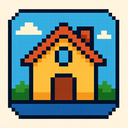
```html The icon under description is a masterful fusion of three distinct yet harmoniously interwoven concepts: the vast, interconnected digital universe of the Internet, the intimate and personal sanctuary represented by a house, and the nostalgic aesthetic of pixel art. This 32x32 pixel canvas captures a moment where technology and home meet in an elegant visual symphony that speaks to both digital natives and retro enthusiasts alike. At first glance, the icon presents itself as a modest yet meticulously crafted dwelling rendered in classic 8-bit style. The house is composed of crisp, blocky pixels with clean edges—hallmarks of authentic pixel art craftsmanship. The structure stands proudly on a simple rectangular foundation that mimics a concrete slab or wooden porch, built from darker gray and brown tones to establish depth and grounding. Its main body features a bright white square base, evoking the clean lines of modern minimalist architecture, but softened by the inherent limitations of low-resolution rendering. The house’s roof is perhaps its most striking feature: a red triangular peak made entirely of pixelated squares in varying shades—ranging from burnt crimson to deep maroon—arranged to simulate a hand-drawn, slightly tilted roofline. The roofing pattern subtly suggests shingles, achieved through alternating rows of darker and lighter pixels that create the illusion of texture without exceeding the 32x32 pixel canvas. This level of detail is remarkable in such a small space, demonstrating the precision required in true pixel art. What transforms this seemingly ordinary house into a digital landmark is its integration with Internet symbolism. Embedded within the roof’s peak, seamlessly merged with the red shingles, lies a glowing blue antenna—composed not of traditional metal but of animated pixel dots forming an upward-pointing wave pattern. This antenna doesn’t simply point skyward; it pulses faintly in two distinct colors—electric blue and cyan—suggesting active data transmission. The animation is subtle: the light flickers every half-second, giving the impression that this house isn’t just a static structure but a dynamic node in an invisible network. Further enhancing the Internet theme, small pixelated "Wi-Fi" symbols float around the house like digital fireflies. These are rendered as stylized concentric circles with three short rays emanating from their center—classic Wi-Fi iconography reduced to just 4x4 pixels per symbol. They hover slightly above the roof and descend gently toward the front door, suggesting a strong signal reception throughout this digital domicile. The front door of the house is painted a vibrant yellow, standing out against the white walls and red roof. It features two distinct pixel elements: a doorknob made from four dark blue squares arranged in an octagon pattern (representing a knob’s circular shape in low-res), and above it, a small green rectangle—symbolizing an electric doorbell button that occasionally flashes when activated. When viewed at normal size, this tiny element suggests interactivity, hinting that this house is not just observed but can be engaged with. On the left side of the house, a pixelated window glows faintly from within. It’s rendered in a light blue tint with four central squares representing glass panes and two darker squares forming a frame. Inside the window, an animated sequence shows three small moving dots—representing data packets or digital characters—travelling through space in slow orbit, creating the visual impression of activity and connectivity. The background of the icon is not flat but subtly layered. A soft gradient in deep purple and navy blue suggests a night sky—a common backdrop for digital icons that represent connectivity. Scattered across this sky are tiny white stars, each represented by single pixels or clusters of two or three adjacent pixels, reinforcing the sense of space and data flow. The icon’s overall color palette is intentionally limited—only 16 distinct colors from a traditional 8-bit palette—yet it manages to convey complexity. This deliberate limitation honors pixel art traditions where every color choice has purpose. The red roof, blue antenna, yellow door, white walls, and green button all stand out clearly due to careful contrast selection and strategic placement. Functionally and symbolically, this icon represents a modern digital home—a safe haven in the vast Internet landscape. It suggests that the house is more than a physical structure; it’s a hub of online interaction, privacy protection, and personal expression. In today’s hyperconnected world, where many people live part of their lives online—working from home offices, hosting virtual gatherings via video calls—it becomes an apt metaphor: the Internet isn’t just something we access; it’s something we inhabit. The pixel art style adds a layer of emotional resonance. It evokes memories of classic video games like Super Mario Bros., The Legend of Zelda, or early Pokémon titles—times when digital experiences felt simpler but more magical. By using this aesthetic, the icon doesn’t just depict a house on the Internet; it celebrates the charm and creativity embedded in early digital culture. In essence, this 32x32 pixel icon is a miniature masterpiece that blends architectural symbolism with networked identity through retro visual language. It captures not just how we connect online—but how we create homes within those connections. The Internet House is more than an icon; it’s a nostalgic promise: no matter how vast and complex the digital world becomes, there will always be a pixelated sanctuary waiting for us at the end of the signal line. ```
Create your own icon with our GoGPT AI prompt:
GoGPT