

Internet Road Steampunk Free icon download
Download all to grab every PNG variant.
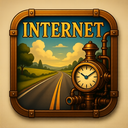
The Steampunk Internet Road icon is a masterful amalgamation of three powerful symbolic elements—Internet, Road, and Steampunk—crafted into a single emblem that captures the essence of modern digital connectivity reimagined through the lens of industrial revolution aesthetics. This intricate design transcends mere visual appeal; it serves as a metaphor for humanity's journey through time—from ancient pathways to fiber-optic highways—while simultaneously reflecting our fascination with retro-futuristic technology and analog craftsmanship.
At the heart of this icon lies a grand, ornate road that appears both physical and virtual. The road is not made of asphalt or concrete, but rather forged from polished brass and aged iron plates interlocked with rivets as large as human hands. Its surface bears intricate patterns reminiscent of circuit boards—etched in gold leaf and glowing faintly with an inner light—suggesting that this is no ordinary path, but a digital artery pulsing with data. The road curves like a sinuous serpent, weaving through the frame from the lower left to the upper right corner, symbolizing both physical travel and the transmission of information across vast distances.
Along each side of the road run steam-powered rail tracks made of cast iron, complete with ticking valves and brass pistons that occasionally hiss with warm vapor. These are not for trains but serve as symbolic conduits for data flow—an homage to how early communication systems like telegraphs once relied on mechanical signals. The rails emit a soft blue glow from within, pulsing rhythmically in sync with the imagined hum of a network heartbeat.
What transforms this scene into something truly visionary is the fusion of Victorian-era machinery with digital elements. Looming above the road are towering, gear-driven towers reminiscent of clockwork lighthouses. Their faces display rotating dials calibrated not to time, but to bandwidth and server load. Each tower is crowned with a spinning brass propeller that resembles an old-fashioned radio antenna—except instead of broadcasting music or signals through airwaves, it channels streams of light from the fiber-optic threads woven into its structure.
These glowing threads—woven like spider silk between the towers—are the literal representation of modern internet connectivity. They pulse with a vibrant cyan and magenta light, mimicking data packets in motion. Some threads are thick and bold, symbolizing high-speed broadband; others are fine as filaments, representing mobile or low-latency connections. Along their lengths hang tiny brass orbs—each one a node in the network—some flickering green (active), others red (offline), creating a dynamic visual map of online presence.
On the road itself, miniature steam-powered carriages glide silently forward. These vehicles resemble vintage locomotives with polished copper bodies, glowing coal-burning furnaces under their chassis, and large gears turning in reverse on each axle to generate power for onboard circuitry. Inside each carriage is a small screen displaying fragmented code or scrolling text—a nod to how modern travelers carry the digital world with them wherever they go. The wheels are not rubber but interlocking cogwheels, grinding softly against the iron road, producing a mechanical whir that blends with the faint electric hum of data transmission.
At key intersections along the road stand massive brass arches adorned with intricate filigree and stained-glass panels depicting digital symbols—Wi-Fi signals, binary sequences, and even stylized emojis—all rendered in the manner of Victorian stained glass. These arches serve as gateways between different network zones: one might feature a map of global data centers labeled in old English script; another shows constellations formed not by stars but by satellites orbiting Earth.
The background is an ethereal blend of smog-filled skies and glowing circuitry. Smoke from steam vents drifts upward, dissolving into digital mist that forms ephemeral cloud icons. In the far distance, a colossal brass globe rests atop a tripod of mechanical limbs—its surface covered in engraved road networks and fiber-optic veins pulsing with light. This globe represents the interconnected world we now inhabit: physically connected by roads and digitally bound by the internet.
Every element of this icon is meticulously designed to honor all three core keywords:
- Internet: Through glowing data threads, digital nodes, network arches, and real-time status indicators embedded in each mechanical component.
- Road: As the central path of movement—both literal and metaphorical—connecting destinations across space and time via a hybrid physical-digital landscape.
- Steampunk: Through the use of brass, copper, iron, gears, pistons, valves, Victorian architecture, and mechanical automation—all fused with futuristic digital concepts in a seamless aesthetic.
The Steampunk Internet Road icon is more than a symbol—it’s an invitation to imagine how the past and future might converge. It reminds us that every click we make on our devices is part of an immense, living network, not unlike the great railway systems of the 19th century. Just as those railways shaped empires, today's internet roads shape civilizations. And in this icon, we see them united: a world where steam still powers progress and code flows through gears.
Whether used in software interfaces, branding for tech startups with a retro flair, or as artwork celebrating the intersection of history and innovation, this icon stands as a testament to human ingenuity—where the road leads not just forward, but into the very soul of digital connection.
Create your own icon with our GoGPT AI prompt:
GoGPT