

Internet Server Pixel art Free icon download
Download all to grab every PNG variant.
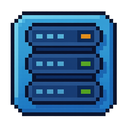
The pixel art Internet server icon is a meticulously crafted digital artwork that masterfully blends nostalgic retro aesthetics with modern technological symbolism. This icon represents the intricate relationship between the global digital network and its foundational infrastructure—servers—while maintaining a charming, low-resolution visual language rooted in 8-bit and 16-bit video game design traditions. At just 32x32 pixels, every single square is purposefully placed to convey complex ideas through minimalistic precision.
The icon’s central subject is a stylized server rack, depicted with the simplicity characteristic of pixel art yet rendered with enough detail to be instantly recognizable. The main body of the server is composed of dark gray and black pixels forming a compact rectangular frame, reminiscent of actual data center hardware. A series of small, brightly colored pixels—shades of cyan, lime green, and electric blue—form LED indicator lights along the top edge. These glowing dots pulse with subtle animation in dynamic versions or remain steady in static forms, symbolizing active data processing and network connectivity.
Extending from the server’s base are two pixelated cables: one connected to a small representation of a globe (a common Internet icon) at the bottom left, and another leading upward to an abstract cloud formation above. The globe is rendered in just 12 distinct pixels—blue for oceans, green for landmasses, with white highlights suggesting reflection—emphasizing the global reach of the Internet. Each pixel on this tiny world contributes to a larger narrative: interconnectedness across continents and cultures.
The cloud element above the server is crafted using layered pixel clusters in varying shades of white and light gray, forming a volumetric shape that suggests both data storage (the "cloud") and atmospheric presence. Tiny spark-like pixels radiate outward from the cloud’s core, representing data packets traveling through fiber optics or wireless networks. These particles are rendered in bright yellow and white to mimic electrical signals or digital transmissions, reinforcing the theme of information flow.
Surrounding the central server structure is a grid-based background composed of repeating patterns—some pixels forming network pathways (thin lines connecting dots), others creating faint circuit board textures. This micro-patterned backdrop subtly suggests the underlying infrastructure that supports Internet operations: physical wiring, circuitry, and data highways. The use of 16 distinct colors ensures visual richness without overwhelming the minimalist pixel art style.
What makes this icon particularly compelling is how it successfully merges three seemingly disparate concepts into a single coherent image: Internet (the global network), Server (the hardware that powers it), and Pixel Art (the medium of expression). The connection between these elements isn’t merely decorative—it’s conceptual. The server, as the physical foundation of online services, hosts websites, applications, and databases that users access via the Internet. By depicting this relationship through pixel art—a medium historically tied to early digital culture—the icon becomes a homage to computing history while remaining relevant in contemporary digital environments.
Despite its small size (typically 32×32 or 64×64 pixels), the icon communicates complex technological ideas with clarity and charm. Every pixel serves a purpose: some define shape, others add color contrast, and a few create depth through shading. The limited palette—often sourced from classic retro game palettes like those used in NES or Game Boy systems—adds to its authenticity while ensuring compatibility across devices with varying display capabilities.
This icon is especially suited for use in retro-style user interfaces, indie video games, mobile applications with nostalgic themes, or as a visual symbol on developer portfolios and tech blogs. It can serve both functional roles (as a menu icon or status indicator) and symbolic ones (representing digital resilience, network strength, or data sovereignty). Its pixelated nature makes it scalable without loss of quality—unlike vector graphics that may appear blurred when upsampled.
Moreover, the choice of pixel art elevates the icon beyond mere functionality. It evokes a sense of wonder and creativity associated with early computing. In an age dominated by hyper-realistic graphics and AI-generated imagery, this pixel-perfect server icon stands as a deliberate celebration of craftsmanship—the artistry involved in creating something meaningful from just 1,024 or 4,096 individual pixels. It reminds viewers that beneath the seamless interfaces of modern technology lies a complex ecosystem of servers working tirelessly to deliver the Internet experience we take for granted.
In essence, this pixel art Internet server icon is more than a visual symbol—it’s a digital artifact. It encapsulates the evolution of computing from 8-bit beginnings to today’s interconnected world. It honors both past and present, combining vintage aesthetics with contemporary significance. Whether displayed in a minimalist app interface or featured on a developer's GitHub profile, this icon speaks volumes about technology, community, and the enduring power of simple yet profound design.
Create your own icon with our GoGPT AI prompt:
GoGPT