

Literature Camera Steampunk Free icon download
Download all to grab every PNG variant.
```html
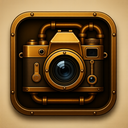
The icon in question is a meticulously crafted visual embodiment of three profound concepts—Literature, Camera, and Steampunk—converging into a single emblem of artistic and intellectual ambition. At first glance, the icon appears as an intricate mechanical device suspended between time periods, but upon closer inspection, it reveals itself as a sophisticated symbol that captures the soul of storytelling through the lens of technological romance.
At its core is a vintage brass-and-iron camera, reminiscent of early 20th-century photographic apparatuses. However, this is no ordinary camera; it bears unmistakable signs of Steampunk design: gears protrude from its sides like ornamental limbs, cogs turn slowly in the background as if driven by unseen steam pressure, and polished copper piping snakes around the body like veins of a living machine. The lens is encased in a rotating brass ring etched with arcane symbols—perhaps alchemical equations or ancient runes that reference forgotten literary codes. A leather-wrapped shutter release knob sits at the top, worn from use yet polished to a soft glow by time and devotion.
What distinguishes this icon from mere mechanical fantasy is its integration of literature as both theme and function. Instead of a traditional film reel or digital storage medium, the camera’s interior reveals an elaborate scroll mechanism. Wrapped around a central brass spindle, hundreds of tiny paper scrolls—each no larger than a finger nail—unspool like threads of memory. These scrolls are inscribed with delicate script: fragments of poetry, quotations from classic novels, lines from plays and philosophical treatises. Each scroll is labeled in cursive with the titles or authors whose words it carries: "Shakespeare," "Dickens," "Brontë," "Wilde." The mechanism suggests that every photograph taken by this camera does not simply record light but captures intangible human experience—emotions, thoughts, dreams—translating them into literary form.
The camera’s viewfinder is not a glass lens but a small, circular window of frosted amber crystal. When viewed through it, one does not see an image in the conventional sense; instead, scenes from imagined stories unfold: a Victorian gentleman reading under gaslight while smoke curls from his pipe, a lone poet writing by candlelight as storm clouds gather outside her window. These visions are not static but animated—flickering like old film reels—suggesting that this camera does not merely photograph reality but conjures narrative potential from the fabric of existence.
At the base of the device rests a small, open leather-bound journal secured with brass clasps. The pages are made from aged parchment and bear ink stains as if written in haste. Scattered across its surface are sketches—doodles of steampunk contraptions, diagrams for mechanical pens, and marginalia that read: "The book is the first photograph." This journal serves as the camera’s companion, a literary archive where every image taken is simultaneously transcribed into narrative. Thus, each captured moment becomes not just a picture but a short story or an excerpt from a larger novel.
The entire icon pulses with subtle mechanical rhythm—the ticking of tiny clockwork gears, the gentle hiss of steam escaping from vented valves. A faint glow emanates from within the brass casing, like the inner fire of inspiration. This light is not electric but fueled by something more metaphysical—perhaps the collective imagination of all who have ever written or read a book.
Even the stand on which this icon rests is a masterpiece of Steampunk design. It resembles an ancient library ladder, constructed from twisted iron and aged wood, with brass brackets that hold scrolls and quills like trophies. At the top, where the camera would normally be mounted, a tiny bookshelf extends outward—a shelf holding not volumes but miniature photographic plates in glass cases.
Symbolically, this icon speaks to the deep connection between storytelling and recording. Literature has always sought to preserve moments—of joy, sorrow, love, revolution. The camera has been humanity’s tool for freezing time. Here, these two forces are united through the lens of Steampunk: a world where imagination fuels technology and technology inspires art. It is a tribute to authors who see life as a series of scenes to be framed, and photographers who believe every image holds an untold story.
In essence, this icon represents not just an object but a philosophy—a belief that the written word and the captured image are two sides of the same coin: expressions of human consciousness. It stands as a monument to those who write with their eyes and photograph with their hearts. In a world increasingly digital and fleeting, this Steampunk literary camera reminds us that meaning is not found in pixels but in purpose, in narrative, in the enduring beauty of craftsmanship.
More than an icon, it is an invitation: to look deeper into the world around you, to see stories where others see silence. To turn a page and find a photograph. To press the shutter and write a chapter. In this fusion of literature, camera, and steampunk elegance lies the soul of creative vision.
```Create your own icon with our GoGPT AI prompt:
GoGPT