

Literature Drone Retro Free icon download
Download all to grab every PNG variant.
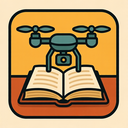
The icon embodies a rare fusion of three seemingly disparate concepts—literature, drone technology, and retro design—into a single, visually compelling symbol that tells a story about the evolution of human expression and the technological dreams that have carried it forward. This is not merely an emblem; it is an artifact from an alternate timeline where storytelling was always intertwined with mechanical advancement. At first glance, one might see only a nostalgic design reminiscent of 1980s sci-fi aesthetics, but upon closer inspection, the icon reveals layers of meaning that reflect the enduring power of narrative and our fascination with flight. The central element is a stylized flying machine—clearly a drone—but far removed from modern minimalist designs. Instead, it resembles something out of an old science fiction novel or a vintage arcade game. Its body is shaped like an oversized typewriter key, specifically the "Q" key, suggesting not only mechanical precision but also the foundational role of writing in human progress. The metallic gray casing is adorned with brushed aluminum patterns and faintly glowing blue circuit lines that pulse rhythmically, evoking both vintage electronics and futuristic energy. These circuits are arranged to form subtle literary symbols: a semicolon here, a quotation mark there, a period hidden within its wing joint—microscopic nods to the language that has shaped civilizations. Hovering above the drone's central core is a floating book, seemingly suspended in mid-air by invisible forces. The book is rendered with painstaking detail—a weathered leather cover with embossed gold lettering that reads “Echoes of Tomorrow,” a title that hints at both literary depth and forward-looking vision. Its pages are slightly open, revealing handwritten text in faded ink, as if the drone has just paused mid-flight to read a passage aloud. One page even contains a diagram resembling an early radio antenna or satellite dish, merging the physical act of reading with technological advancement. The drone’s "wings" are not conventional rotors but rather resemble old-fashioned fan blades from 1960s air conditioning units—complete with riveted edges and visible gear mechanisms. They spin slowly, silently, as if powered by imagination rather than electricity. Each wingtip carries a small retrofuturistic light: one emits a warm orange glow like an incandescent bulb from the 1950s; the other pulses in a soft cyan hue, reminiscent of early cathode-ray tube screens. Together, they suggest a duality—warm human emotion and cool technological logic—echoing the balance between heart and mind that literature seeks to capture. The base of the icon is shaped like an analog tape recorder from the 1970s: black plastic with rounded edges, silver knobs, and a cassette slot. But instead of holding audio cassettes, it contains a glowing reel of paper—like endless pages from a book—spinning slowly. This detail signifies that stories are not static; they are recorded, replayed, and reinterpreted through time. The tape recorder itself is partially submerged in what appears to be old-style typewriter ribbon spools, suggesting the mechanical labor behind literary creation. The color palette is carefully curated to reflect the retro essence: deep charcoal grays, warm sepia tones for aged paper textures, electric blue for glowing circuits, and muted golds for ornamental details. Every hue recalls a specific era—the glow of neon signs from 1980s cityscapes, the grainy warmth of VHS tapes, the crisp white pages of mid-century books. Yet these retro elements are not mere decoration; they serve as metaphors. The worn edges on the book’s cover suggest stories that have been read and re-read across generations. The visible screw heads on the drone's casing hint at a time when machines were built to be repaired, not replaced—mirroring how literature is preserved, annotated, and passed down. One of the most striking aspects of this icon is its implied motion. Despite being static in image form, it conveys a sense of gentle flight—a literary drone drifting through the skies like a guardian angel for lost tales. It might be imagined as flying over ancient libraries with crumbling spires or hovering above city rooftops where poets once whispered verses into wind turbines. In this way, the icon becomes more than visual—it’s narrative itself. The fusion of literature and drone technology speaks to humanity’s enduring desire to transcend boundaries: both physical (through flight) and intellectual (through storytelling). The retro aesthetic grounds this vision in nostalgia but also challenges viewers to consider what might have been if early 20th-century writers had envisioned drones not as military tools, but as vessels for literary expression—carrying poetry across deserts, delivering novels to remote villages, or scanning ancient manuscripts mid-flight. This icon is more than a design; it’s an invitation. It invites the observer to imagine a world where every book has wings, where every story can take flight. It honors the past while daring to dream of what stories could become when infused with technology and wonder—crafted not in cold code, but in warm ink and retro spirit.
Create your own icon with our GoGPT AI prompt:
GoGPT