

Literature Satellite Origami Free icon download
Download all to grab every PNG variant.
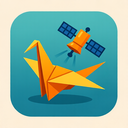
At the heart of modern symbolic design lies an innovative icon that seamlessly fuses three seemingly disparate realms—literature, satellite technology, and origami art. This intricate emblem is not merely a visual representation; it is a profound metaphor for human intellect, global connectivity, and the delicate beauty of creation. The icon embodies a harmonious convergence of imagination and innovation, where the written word meets celestial observation and paper-folding craftsmanship.
At its core stands an elegant origami crane—a universally recognized symbol of peace, hope, and transformation in East Asian cultures. Crafted from a single sheet of paper, this bird is poised mid-flight with wings gently arched as if ascending into the boundless sky. Its form is precise and minimalist yet rich in narrative potential. The crane’s body is composed of geometric folds that suggest both structural integrity and artistic fluidity—each crease a testament to patience, precision, and intentionality. In this context, the origami crane symbolizes literature: not only as physical texts made from folded paper (a nod to ancient scrolls and books), but also as the metaphorical flight of ideas across time and space. Just as a single sheet of paper can become a vessel for epic stories or philosophical reflections, so too can one idea—carefully folded and shaped—transform into a powerful narrative that transcends borders.
Emerging from the crane’s outstretched wings is a sleek, futuristic satellite. This satellite is rendered with clean lines and metallic sheen, its solar panels unfurled like wings in perfect synchronization with the origami bird. Its surface displays intricate circuitry patterns that resemble calligraphy or ancient script—symbolically blurring the line between technological advancement and literary expression. The satellite orbits a stylized Earth, not as a distant object but as an interconnected node in a global network of knowledge. This fusion underscores how modern literature is no longer confined to print; it travels through digital networks, broadcast from satellites that enable instant communication across continents. In this way, the satellite represents the vast infrastructure supporting the dissemination of ideas—how stories, research papers, and poetry now reach audiences in real time via global connectivity.
The Earth below is depicted with subtle cartographic features, including delicate lines suggesting rivers and mountain ranges. However, instead of a conventional representation, it appears as if the continents are formed from folded paper—a direct continuation of the origami theme. The continents emerge from creases that suggest they were once flat and then carefully shaped into geographical form. This choice reinforces the icon’s central metaphor: just as literature shapes our understanding of reality through narrative and imagination, so too does technology reshape how we perceive and interact with the world. The Earth-as-origami is a poetic reminder that perception itself is a product of interpretation—whether through literary lenses or satellite imagery.
In the background, faint starlight patterns form constellations that subtly resemble ancient manuscripts. Some stars align to spell out fragments of famous literary passages, such as lines from Shakespeare’s sonnets or haikus by Matsuo Bashō. These celestial writings emphasize the timeless nature of literature and its enduring presence in human consciousness—just as satellites chart the night sky for navigation, so too does literature guide our moral and emotional journeys. The stars also serve to elevate the icon into a cosmic context, suggesting that storytelling is not only terrestrial but universal—a shared human endeavor that transcends time and space.
Color plays a crucial role in reinforcing these layered meanings. The origami crane is rendered in soft ivory with delicate gradients of deep indigo and silver, evoking both aged parchment and the reflective surface of outer-space technology. The satellite glows with a cool, electric blue—symbolizing innovation and digital connectivity—while the Earth pulses with a gentle green hue, representing life, growth, and environmental consciousness. These colors do not clash but harmonize like notes in a well-composed symphony, reflecting the balance between tradition (literature), progress (satellite tech), and artistry (origami).
Ultimately, this icon is more than a symbol; it is an invitation to reflect on how human creativity bridges disciplines. Literature provides the stories we live by. Satellite technology extends our reach across planets and minds. And origami teaches us that even the simplest materials—paper, thought, energy—can be transformed into something enduring and beautiful when folded with care and vision. Together, these elements form a powerful visual narrative: that every idea begins as a flat sheet of potential—and through imagination, technology, and artistry, it can rise into the sky like a paper crane guided by the stars.
Whether displayed on digital platforms, printed in books of philosophy or science fiction, or engraved into architectural elements of libraries and research centers, this icon stands as a beacon of interdisciplinary unity—an eternal reminder that stories matter, knowledge travels fast, and beauty is born from careful folding.
Create your own icon with our GoGPT AI prompt:
GoGPT