

Medicine Bus Cyberpunk Free icon download
Download all to grab every PNG variant.
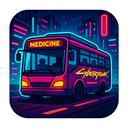
The icon is a striking fusion of futuristic urban design and biotechnological urgency, encapsulating the convergence of medicine, public transit, and cyberpunk aesthetics into a single visual narrative. At its core lies a repurposed city bus—an elongated, rusted-metal chassis now transformed into an autonomous medical transport unit—suspended in an electrically charged atmosphere of neon-drenched dystopia. The vehicle’s original livery has been obliterated by layers of glowing circuitry, holographic panels, and pulsating bio-luminescent veins that snake along its frame like synthetic nerves. This is no ordinary public bus; it is a mobile medical ark in the heart of a crumbling metropolis where healthcare has become an underground commodity traded in data packets and neural implants.
The front end of the bus reveals a digital face composed entirely of shifting neon glyphs—glitching symbols for "EMERGENCY MEDICINE," "CURE," and "NEURAL REBOOT"—flickering in multiple languages, each one flashing with a different color: deep cobalt blue, electric violet, and toxic green. These are not mere advertisements; they are warnings, promises, and psychological triggers designed to attract the desperate. Embedded within the windshield is a neural interface portal—a circular ring of biometric scanners that can read vital signs from 20 feet away. The glass itself is layered with smart-tint technology that adjusts opacity based on emotional distress levels detected in nearby pedestrians.
As one gazes upon the body of the vehicle, they notice an intricate network of translucent tubing running along its sides, pulsing with a faint blue fluid—synthetic plasma laced with nano-therapeutics. These conduits connect to various ports on the bus’s exterior: injection nozzles for rapid immunization, laser scalpel dispensers for field surgeries, and even micro-drones that detach from undercarriage pods to deliver medication directly into patients’ bloodstream via subdermal implants. The wheels are not metal but bioceramic composites infused with regenerative material—capable of self-healing when damaged—a testament to the fusion of organic resilience and machine precision.
On the roof, a rotating array of solar-fiber panels glows under an artificial sky filled with hovering drones and orbital surveillance satellites. This is not just transportation—it is a mobile clinic powered by both renewable energy and illicit data streams harvested from black-market neural networks. The bus’s exhaust system emits not smoke, but mist-like vapor infused with healing compounds—tiny nanoparticles designed to alleviate respiratory distress in nearby populations. At night, the entire vehicle becomes a beacon: its silhouette illuminated by embedded LED ribbons that pulse in sync with the rhythm of a simulated heartbeat.
Inside the bus, though invisible from outside, one can imagine an environment of sterile chaos—glass-walled isolation chambers for trauma victims, AI-driven diagnostics stations with holographic displays showing real-time patient vitals, and automated robotic arms preparing IVs infused with genetically tailored antibodies. The seats have been replaced with modular medical pods that adjust to patients’ physical needs using biometric feedback. A central core—visible through a transparent panel—houses a quantum-powered neural database containing decades of experimental treatments, many of them illegal or unapproved by global health councils.
The cyberpunk essence is not merely aesthetic but philosophical. The Medicine Bus symbolizes the commodification of health in a world where corporations control access to cures, and only those with the right neural key—or enough encrypted credits—can receive treatment. It represents both hope and danger: a lifeline for those on the fringes, yet also a tool of surveillance and data harvesting. The bus does not simply deliver medicine—it collects data on who is sick, why they are sick, and how they respond to treatment. Every passenger becomes part of an algorithm that predicts future epidemics or identifies potential organ donors.
Moreover, the bus itself is sentient—its AI system named "Healer-9"—capable of making autonomous decisions based on ethical algorithms that prioritize saving lives over legality. It moves through underground tunnels and abandoned transit lines, evading corporate enforcers known as "PharmaCops." Its route changes daily, broadcast only through encrypted channels to the city’s black-market newsfeeds. Some say it was originally a public transport vehicle before being hijacked by rogue med-tech rebels; others believe it is an artificial entity born from the collective desperation of millions who’ve lost faith in traditional healthcare.
In every detail—the flickering neon, the biotech wiring, the ghostly aura of its presence—this icon tells a story. It is a symbol not just of medicine delivered on wheels, but of resistance against systemic neglect. The Bus is no longer about moving people from one place to another; it’s about moving hope through the cracks in society. In this cyberpunk future, where life and death are measured in data points and neural bandwidth, the Medicine Bus stands as a defiant monument: a mobile sanctuary glowing with the promise that healing is still possible—even if it must come wrapped in wires, code, and shadows.
Create your own icon with our GoGPT AI prompt:
GoGPT