

Music Bridge Thin – Free icon download
Download all to grab every PNG variant.
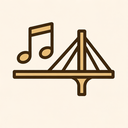
At the heart of this meticulously crafted icon lies a powerful synthesis of three foundational elements: Music, Bridge, and Thin. This is not merely a visual representation—it is an experiential concept, a conceptual bridge that connects abstract emotion with tangible form. The icon embodies the delicate interplay between sound and structure, where music becomes both an expression and a structural framework, and where the quality of 'thin' serves not just as aesthetic detail but as symbolic essence.
The central motif of this icon is a slender, elegant bridge—constructed not from concrete or steel, but from flowing lines that suggest musical notes. The bridge stretches across a vast horizontal space, symbolizing connection: between people, between cultures, between past and future. But unlike conventional bridges that represent physical infrastructure, this one is an invisible conduit of harmony. It does not merely span a gap; it resonates with the vibrations of sound itself. Each beam of the bridge is shaped like a musical stave or a waveform, subtly undulating to mimic the rhythm and cadence of music—be it classical, electronic, or ambient. The bridge’s structure is composed entirely from thin lines, emphasizing fragility and lightness. This 'thin' quality reflects both the emotional transparency of music and the minimalism required to express profound human connections.
Music in this icon is not merely a background element—it is the very foundation upon which the bridge exists. The notes that form its arches are not static symbols; they are dynamic, pulsing with rhythm. A single note at one end of the bridge might represent a solo violin melody, while at the other end, a sustained chord suggests harmony and unity. The thin lines that compose these notes do not lose clarity or power despite their minimal thickness—they instead amplify their presence through precision and intention. This reflects how music can be deeply moving even when expressed in simple forms—how silence between notes is just as important as the sound itself.
The bridge, therefore, becomes a metaphor for communication. It connects disparate entities—individuals in different places, cultures with different traditions, generations with evolving tastes. In a world where digital communication often lacks emotional depth, this icon suggests that true connection occurs through shared aesthetics and shared language. Music acts as the universal language that transcends borders and languages; the bridge is its physical manifestation. This thin bridge is not robust or impenetrable—it is easily seen through, almost transparent—symbolizing accessibility. Anyone can walk across it without needing a key, no invitation, no expense. Just as music can be enjoyed by all regardless of background, this bridge invites approachability and openness.
Moreover, the 'thin' nature of the icon reflects a philosophical stance on minimalism in design and meaning. In a world saturated with heavy content—large images, dense data, overwhelming noise—the thin bridge stands as an antidote. It reminds us that profound experiences often come from simplicity. A single note can evoke an entire memory; a quiet pause in music can be more powerful than any crescendo. The icon’s thinness echoes this principle: less is more, and clarity enhances emotional impact. Even the absence of color or saturation emphasizes the purity of sound and connection—there is no distraction, only resonance.
From a design perspective, the icon leverages modern visual language to express complex ideas. The bridge uses clean geometric lines that are consistent with contemporary minimalism. These thin lines have been carefully weighted so that they maintain structural integrity while remaining visually delicate. The music elements are not drawn as clusters of symbols but as continuous, flowing curves that suggest motion and time—like a piano’s keys being pressed or a guitar string vibrating. The thinness allows the viewer to focus on form and movement rather than detail, creating an almost meditative experience.
Symbolically, this icon can be interpreted in multiple dimensions. It could represent a digital platform connecting musicians globally through shared playlists and live streams—where the bridge is the internet, thin yet powerful. Or it might reflect the emotional journey of a person discovering music that bridges loneliness with community. The thinness suggests vulnerability—exposure to feeling, openness to change—but also strength in simplicity.
Additionally, this icon has cultural significance. In many traditions, bridges are symbolic of transition—between life and death, between worlds. Here, the bridge becomes a transitional space for musical transformation: from silence to sound, from isolation to harmony. The 'thin' quality reinforces that such transitions are not always dramatic—they can be gentle and subtle, like a soft melody rising through a quiet room.
Ultimately, this icon transcends its visual form. It is an invitation—a call to experience music as both art and architecture. It teaches us that connection does not require grand gestures; sometimes, the most meaningful bridges are thin, simple, and made of sound. The fusion of Music, Bridge, and Thin creates a powerful narrative where emotional depth meets structural elegance—an icon not just for designers or artists, but for anyone who believes that music can build communities and that simplicity can carry profound meaning.
In conclusion, the icon described by the keywords Music, Bridge, and Thin is more than a visual piece—it is an experience of resonance. It speaks to human longing for connection, to the beauty found in simplicity, and to the enduring power of music as both a universal language and a structural metaphor. Its thinness is not weakness; it is intentionality. Its bridge is not built of steel or stone—it is built on shared emotion, rhythm, and understanding. In every glance at this icon, one hears the melody of unity.
Create your own icon with our GoGPT AI prompt:
GoGPT