

Music Dollar sign Cyberpunk – Free icon download
Download all to grab every PNG variant.
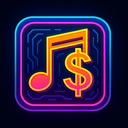
This intricate, high-fidelity icon embodies a fusion of three powerful, contrasting yet harmonious themes: Music, the Dollar Sign, and the immersive world of Cyberpunk. It is not merely an artistic composition; it is a visual metaphor for the future of digital culture—a world where emotion, commerce, and technology converge in a neon-lit, high-tech dystopia. The icon serves as both an aesthetic symbol and a conceptual gateway into the evolving relationship between artistic expression and economic systems in a hyper-connected society.
At its core lies a neon-pulsing musical waveform, rendered in deep electric cyan, magenta, and vibrant yellow. The waveform is not static—it subtly vibrates with motion blur, mimicking the heartbeat of an underground cybernetic system. Each wave peak and trough carries a shimmering digital sheen that reacts dynamically to the surrounding environment, as if tuned to ambient sound frequencies. Embedded within this waveform are micro-animations of tiny holographic notes—G, A, C—floating like data particles in mid-air. These notes represent not only music as art but also as currency: the very act of listening can trigger value transactions in a decentralized network known as "Sonar Finance," where sound waves are converted into digital assets.
The Dollar Sign is not a simple symbol here. It has been reimagined through the lens of cyberpunk design—transformed from a flat, bureaucratic icon into a three-dimensional, augmented reality element. The dollar sign appears as an abstract geometric structure composed of intersecting circuits and glowing data streams. Its edges are sharp and angular, reminiscent of server racks or neural net architectures. Instead of representing mere money, it symbolizes the commodification of experience—how music becomes a tradable asset in a world where emotions are measured, monetized, and shared through blockchain-based platforms. In this context, the dollar sign pulses in sync with the music waveform: when a beat hits its peak, the dollar sign flares with white light; during quieter moments, it dims into deep indigo—creating an emotional rhythm that mirrors financial volatility.
The backdrop of this icon is a dense cyberpunk metropolis. A vast cityscape stretches behind the central elements—a vertical city composed of towering holographic billboards, flying autonomous drones, and data-slick canyons where information flows like rivers. Buildings are constructed from recycled nanomaterials, with surfaces that shift color based on real-time sentiment analysis of ambient sound. The sky is a perpetual twilight: part night, part neon glow from floating data orbs and surveillance drones. This environment reinforces the idea that music and money do not exist in isolation—they operate within a networked reality where every note heard can influence economic value, social status, or even access to exclusive digital experiences.
The interplay between Music and the Dollar Sign is central to the icon’s narrative. In this future, music is no longer passive entertainment—it becomes an active economic force. A single song released on a decentralized platform can be licensed, sampled, and sold across multiple markets. Artists are rewarded not just with royalties but with real-time analytics showing how their tracks generate emotional responses that correlate directly to user engagement and spending behavior. This is where the cyberpunk aesthetic becomes crucial: it reflects a world where technology has advanced beyond human control, and every experience—especially art—is tracked, analyzed, and monetized through intelligent algorithms.
The icon also features subtle references to augmented reality (AR) integration. When viewed through compatible smart-glasses or AR-enabled devices, the icon "activates" in layers—revealing hidden elements such as embedded lyrics that appear only when a user listens to a specific frequency, or real-time stock prices fluctuating with the tempo of a song. For instance, during an intense drop in music intensity (a sudden silence), the value of certain digital assets might dip; during explosive beats, asset values surge. This creates an immersive feedback loop between auditory experience and financial outcomes—blurring the line between art and commerce.
Furthermore, the icon reflects a societal shift where traditional notions of ownership are obsolete. Instead of owning music or money in a literal sense, individuals "subscribe" to soundscapes or participate in sonic economies through digital tokens. A person might pay for access to a limited edition track by contributing to an open-source music vault, and their contribution is recorded as part of the blockchain ledger—visible only through AR overlays. This system embodies the cyberpunk ideal: a world where identity is fluid, value is dynamic, and creativity is both personal and participatory.
The visual design of the icon itself draws from cyberpunk aesthetics popularized in works like *Blade Runner*, *Neon Genesis Evangelion*, and *Ghost in the Shell*. It uses high-contrast color palettes—deep blacks, electric blues, blood reds—and a gritty texture to convey urban decay and technological advancement. Yet within that bleakness lies warmth: the music pulses with life, the dollar sign glows with potential, and together they form a resilient symbol of human expression in a machine-dominated world.
Ultimately, this icon represents more than just a design—it stands as a visionary statement about the future of culture. In a world increasingly dominated by algorithms and artificial intelligence, music remains one of the few truly human forms of expression. The integration of financial value into that expression through cyberpunk technology does not diminish its emotional depth; rather, it expands its reach—making art more accessible, more equitable, and deeply tied to the rhythms of daily life. This icon is a beacon for artists, entrepreneurs, and technologists who believe that sound can shape economies and emotions alike in a future where humanity remains at the center of innovation.
Whether displayed on a wearable device, embedded in an AR app, or featured as part of a digital art gallery in the 2070s metropolis of Neo-Singapore, this icon will continue to evolve—responding to new sounds, reflecting shifting economic conditions, and echoing the persistent human desire for connection through music and value.
"In the neon silence of the future, music becomes money. And money, in turn, becomes music."
Create your own icon with our GoGPT AI prompt:
GoGPT