

Music Guitar Digital glitch – Free icon download
Download all to grab every PNG variant.
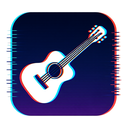
Description of the Icon: "Music, Guitar, and Digital Glitch"
This meticulously crafted digital icon synthesizes the organic warmth of traditional music with the disruptive energy of modern technology. At its core lies a powerful fusion of three distinct yet interwoven elements: Music, Guitar, and Digital Glitch. The icon does not merely depict one or two of these themes — it embodies their dynamic tension, creating a visual narrative that speaks to the evolving relationship between human creativity and machine intervention.
The central form of the icon features a stylized electric guitar, rendered in a minimalist yet expressive way. The guitar is not just an object; it is an animated presence. Its body is composed of flowing lines that resemble musical notes, vibrating subtly as if in motion. The neck curves elegantly upward, forming a dynamic arc reminiscent of the shape of sound waves — a direct visual metaphor for music itself. Each string is represented as a thin, luminous line, slightly pulsing with soft color gradients that shift from deep blues to electric purples and vibrant magentas. This gives the guitar an almost living quality — not static, but alive with rhythm and resonance.
What sets this icon apart from conventional musical representations is the integration of Digital Glitch. Rather than appearing as a mere background effect or decorative overlay, the glitch element is woven into the very structure of the guitar. Small bursts of digital distortion ripple across its surface — jagged lines, pixelated fragments, and sudden color shifts that mimic screen corruption. These glitches do not represent error; instead, they symbolize transformation. They illustrate how technology can distort reality in creative ways, turning a familiar instrument into something new and unpredictable. The glitch patterns appear most prominently at the guitar’s pickups and frets — areas where analog sound meets digital signal processing.
The music aspect is not limited to the guitar's form. Around it, an abstract wave pattern expands outward like ripples in a pond. These waves are not smooth or regular; instead, they contain bursts of erratic spikes and soft decays, reflecting the chaotic yet harmonious nature of real-world musical compositions. The waveforms themselves are composed of broken segments that flicker in and out — each segment transitioning into another with a slight delay or stutter, echoing the imperfections inherent in human-made music. This digital distortion is not an addition; it's an essential part of how music is perceived today — in streaming platforms, headphones with noise filters, and smart speakers that interpret sound through algorithms.
The color palette plays a critical role in conveying the icon’s layered meaning. Dominant tones include deep indigo, neon cyan, and electric orange — colors associated with both artistic expression and digital technology. However, these are interlaced with bursts of static white noise and black voids where glitches occur. These voids suggest silence — not emptiness, but pause — a moment between notes in a song. The contrast between vibrant color and abrupt darkness mimics the unpredictability of musical improvisation or electronic sound design.
The icon’s background is intentionally abstract, resembling a corrupted digital screen or a fractured audio waveform. This background does not distract from the central guitar; instead, it reinforces the theme of technology's influence on music. In places, you can see faintly visible text fragments — such as “beat,” “loop,” or “error code 7F” — which appear and disappear like phantom data streams. These fragments suggest that music is no longer just something created by hands; it is now generated, shared, and interpreted through digital systems.
From a design perspective, the icon balances organic aesthetics with cybernetic precision. The guitar’s curves follow natural forms found in nature — like ripples or flowing water — while the glitch elements adopt sharp geometric patterns common in digital art. This duality reflects how modern music production blends analog instrumentation with digital tools such as synthesizers, MIDI controllers, and AI-powered composition software. Even a simple guitar can now be transformed into a virtual instrument through digital processing, producing sounds that were once impossible to achieve.
Furthermore, the icon suggests a philosophical dimension. In an age where music is increasingly algorithmically generated or filtered by artificial intelligence, this piece serves as a reminder of humanity’s enduring connection to musical expression. The guitar — an instrument born from physical labor and emotional experience — stands in contrast to the cold logic of digital glitches. Yet, rather than being enemies, they coexist in harmony. The glitch is not destroying the music; it is redefining it.
Each time a user views this icon, they are invited to reflect on their own relationship with music and technology. Is music still something personal and human when it’s generated by code? Does a distorted sound still carry emotion if its original form has been altered? The icon poses these questions without answering them — instead, it presents them as open-ended reflections.
For musicians, this icon might symbolize the modern creative process: using vintage instruments alongside digital tools to produce innovative sounds. For tech enthusiasts, it could represent the beauty of data corruption and the unexpected creativity that emerges from technical failures. For art lovers, it’s a visual representation of how music has evolved — not just in sound, but in form and perception.
In summary, this icon transcends simple illustration. It is a conceptual bridge between analog emotion and digital imperfection. By merging the warmth of a guitar with the chaos of digital glitches and the rhythm of music itself, it creates a powerful visual metaphor for contemporary artistic expression. It does not just represent music — it reimagines what music can be in the age of technology.
Whether viewed as a logo, a design element, or an artistic symbol, this icon invites viewers to listen beyond what they see — to hear the silence between notes, to feel the vibration in distorted signals, and to recognize that even in chaos lies harmony. It is music born from both hands and circuits — human and machine — united in a symphony of sound, structure, and digital imperfection.
Create your own icon with our GoGPT AI prompt:
GoGPT