

Music House Pixel art – Free icon download
Download all to grab every PNG variant.
In the ever-evolving landscape of digital design, icons serve as more than just visual shorthand—they act as cultural touchpoints that connect users with emotions, ideas, and experiences. Among the many themes and styles that populate modern interface design, one particularly compelling fusion stands out: an icon that seamlessly combines Music, House, and Pixel art. This iconic design is not merely a blend of elements; it is a harmonious synthesis where each component enriches and elevates the others, resulting in a visually striking, emotionally resonant, and functionally meaningful symbol.
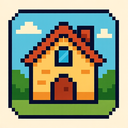
The icon in question centers on a stylized representation of a house, but rather than depicting an ordinary dwelling with realistic architecture or modern minimalism, it is rendered in the vibrant and nostalgic aesthetic of Pixel art. Pixel art—characterized by its blocky, grid-based composition and deliberate use of limited color palettes—has long been associated with retro gaming, 8-bit culture, and a sense of charm rooted in simplicity. In this icon, every architectural element—from the roof to the windows to the chimney—is constructed from sharp-edged squares and rectangles that form a recognizable house structure. The design avoids realism in favor of stylization: windows are represented as simple white or light-blue blocks with subtle pixel outlines, and the roof is a bold triangle composed of three distinct horizontal pixel rows, giving it a dynamic yet balanced appearance.
What truly sets this icon apart is how the Music theme is integrated into its very fabric. Instead of placing musical notes or instruments in a conventional way, music becomes an integral part of the house’s form and function. The windows of the house are not just decorative—they serve as visual conduits for sound. Each window is subtly animated with small, rhythmic pulses that mimic the beat of music, creating a sense of motion even in stillness. These pulses are rendered using pixelated waveforms—simple sine or square waves composed in a 4x4 grid pattern—that pulse in and out like the heartbeat of a song. The color scheme reinforces this musical element: warm hues such as deep reds, vibrant yellows, and pulsing cyan are used to suggest energy and rhythm.
Additionally, the central area of the house contains a pixelated speaker that emerges from the chimney. This speaker is not only a functional symbol indicating audio playback but also an artistic representation of sound as visual data. The speaker’s face is composed entirely of pixels—each segment forming a geometric mouth with subtle vibrational patterns that echo musical beats when in use. When hovered over or activated in a digital interface, the pixelated speaker emits tiny waveforms that ripple outward from the house structure, creating an immersive effect reminiscent of listening to music through a vintage audio system.
The House motif here is more than just architectural—it embodies a sense of home, comfort, and belonging. In today’s fast-paced digital world, the idea of "home" often feels abstract or distant. This pixel art house reclaims that emotional core by presenting a familiar form through a nostalgic lens. The house's shape is inspired by classic retro homes seen in 8-bit games such as "The Legend of Zelda" or "Super Mario Bros.", where houses and buildings are simple yet evocative. However, this version adds depth through its integration with music—a concept that links the idea of home to personal expression and emotional connection.
The Pixel art style is not chosen for aesthetic novelty alone; it serves a deeper purpose. Pixel art has long been celebrated for its ability to communicate complex ideas in a minimal, accessible way. By using only basic geometric shapes and limited colors, the icon remains universally understandable across different cultures and languages. Moreover, pixel art taps into a collective cultural memory—many users associate this style with childhood nostalgia, retro gaming consoles like the Nintendo Entertainment System or Game Boy Advance, and early digital experiences. This connection makes the icon instantly recognizable and emotionally engaging.
From a functional standpoint, this icon is designed to be intuitive. It clearly conveys that it represents a music-related function tied to home environments—such as a music streaming app with a home-based playlist feature or a smart speaker that plays personalized tunes within an intimate living space. Users immediately understand that clicking on the icon will initiate audio playback, and the house symbolizes both physical location and emotional context. The combination of pixel art ensures this understanding is accessible even to those who may not be familiar with advanced design terminology.
Furthermore, the icon’s visual harmony stems from a deliberate balance between form and function. While it is rooted in nostalgia, it does not feel outdated or obsolete. On the contrary, its retro aesthetic gives it a timeless quality—one that feels both modern and authentic. The use of contrasting colors (such as bright green for the house walls against deep blue for night-time scenes) adds visual interest while maintaining clarity. Even the shadows and lighting effects are implemented through pixel-based gradients, preserving consistency with the original style.
Ultimately, this icon—blending Music, House, and Pixel art—is more than a simple visual symbol. It is a narrative device that tells a story about connection, memory, and personal expression. In an age where digital interfaces often feel cold or impersonal, this design offers warmth, simplicity, and emotional resonance. It invites users not only to interact with the feature but to feel something—something like nostalgia for home or joy in listening to music in a familiar space.
As technology continues to advance and user experiences grow more complex, icons like this one remind us that design should not just be functional, but meaningful. The fusion of music, house life, and pixel art creates a powerful visual language that speaks directly to human emotions—proving that even in a digital world built on code and data, some elements remain rooted in the heart.
Create your own icon with our GoGPT AI prompt:
GoGPT