

Music Piano Abstract – Free icon download
Download all to grab every PNG variant.
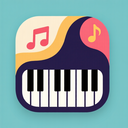
In the expansive and ever-evolving realm of visual design, few concepts encapsulate the emotional resonance of human experience as powerfully as the fusion of Music, Piano, and Abstract. This particular icon is not merely a representation—it is an experiential narrative, a visual symphony that transcends literalism and enters the realm of feeling. At its core, the icon embodies the essence of auditory artistry through a distilled, non-representational form—where every stroke, line, and shape becomes a note in an unseen composition.
The Music aspect is not simply suggested; it is embedded in the very structure of this icon. Rather than depicting traditional musical notation or instruments in a realistic fashion, the design leverages rhythm, harmony, and tempo through dynamic spatial patterns. The icon flows like waves across a canvas—soft curves that swell and recede with an organic rhythm reminiscent of a crescendo or diminuendo. These undulating forms evoke the pulse of sound itself—the subtle vibrations that travel through air and memory, making music not just heard but felt in the body. The use of color gradients mimics how sound frequencies shift: deep purples and rich blues representing low tones, transitioning into vibrant ambers and whites that suggest high-pitched harmonics. This chromatic progression mirrors the emotional journey of a musical piece—starting with introspection, building to intensity, then resolving in serenity.
The Piano element is interpreted not through literal form but as a philosophical and symbolic presence. In this abstract context, the piano does not appear as a set of keys or a wooden instrument with hammers and strings. Instead, each line in the icon functions like a key stroke—thin, sharp lines that emerge from central clusters like notes being struck in sequence. These lines are not parallel or evenly spaced; they vary in length and angle, reflecting the unpredictability and emotional variation inherent in piano playing. Some lines intersect with others to form subtle geometric patterns reminiscent of chord progressions or harmonic overtones. The icon may contain a single central focal point—like a key being pressed—that radiates outward like a sound wave, symbolizing the origin of musical expression. This central axis becomes the emotional core: the moment when silence breaks and music begins, just as in real piano performances where intention and emotion are first expressed through touch.
Yet, what truly defines this icon is its Abstract nature. It resists clear interpretation, refusing to be pinned down by realism or conventional symbolism. This abstraction does not mean it lacks meaning—it means the meaning is discovered through engagement. Viewers are invited to project their own musical experiences onto the image: a child might see a rainbow of notes, while an older listener might perceive echoes of a favorite classical sonata. The form avoids literalism so that it can transcend cultural and personal boundaries—making music accessible not as something learned, but as something felt. The absence of realistic detail forces the viewer to interpret, to listen with their eyes and mind. This abstraction allows the icon to be both universally relatable and deeply individual.
Moreover, this abstract approach aligns with modern design trends that favor emotional resonance over visual clarity. In an age where digital interfaces are saturated with literal representations—icons of phones, coffee mugs, or traffic lights—the abstraction of music and piano offers a refreshing contrast. It encourages contemplation rather than immediate recognition. The icon does not simply signal "music" or "piano"; it suggests possibility, creation, and emotion. It invites users to pause and reflect on their own connection to sound—whether through memory, nature, or personal experience.
The composition is balanced in a way that evokes harmony. There is symmetry in the central structure but dynamic imbalance elsewhere—like a well-composed melody with unexpected turns. The negative space between elements functions as silence, an essential part of music. This deliberate use of empty space enhances the sense of breath and rhythm within the design. It suggests that even absence can be expressive—a key principle in both music and visual art.
Color plays a critical role in translating sound into visual form. The palette is intentionally muted yet evocative—deep indigo, soft gray, and gold accents that simulate the way light reflects off piano keys when struck. When illuminated, certain areas of the icon appear to shimmer like echoes of sound waves traveling through air. This effect is not literal but metaphorical—an artistic device to suggest movement and resonance.
From a design standpoint, this icon is versatile. It can be used in digital applications such as music apps, creative portfolios, or educational platforms that emphasize emotional intelligence and artistic expression. Its abstract nature ensures it remains timeless—unaffected by trends or shifts in technology. Whether viewed on a smartphone screen or a large digital display, the icon maintains its integrity and emotional depth.
In essence, this icon is more than just a visual representation—it is an embodiment of the synergy between sound and form, between emotion and structure. It captures the spirit of Music through rhythm and tone, incorporates the soul of Piano through expressive gesture, and transcends limitations with its Abstract form. It is a bridge between the auditory world and visual perception—a silent melody that speaks directly to the human heart.
This icon does not just depict music and piano—it redefines how we think about them. In a world often dominated by practicality and efficiency, it stands as a reminder of beauty, emotion, and creativity. It is an invitation: to listen with your eyes, to feel with your mind, and to remember that every note has the power to transform.
Create your own icon with our GoGPT AI prompt:
GoGPT