

Music Train 3D isometric – Free icon download
Download all to grab every PNG variant.
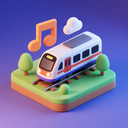
At the intersection of creativity, transportation, and digital design lies a compelling icon concept that beautifully fuses three distinct yet harmonious elements: Music, Train, and 3D isometric. This icon transcends simple visual representation—it embodies a narrative of movement, rhythm, and modernity. Designed with precision, attention to detail, and aesthetic balance, it serves as both a functional symbol and an expressive piece of visual storytelling.
The foundation of this icon is rooted in the 3D isometric design principle—a style that presents three-dimensional objects from a fixed angle using parallel lines at 120-degree angles. This approach offers depth without illusionism, giving a sense of spatial realism while maintaining clarity and accessibility across various digital platforms. In this context, the isometric framework provides a structured yet dynamic canvas where both the music and train elements can coexist seamlessly. Unlike flat icons that might appear two-dimensional or static, the 3D isometric style lends motion and perspective, making the icon feel alive even in still form.
Within this architectural framework, the Train serves as a central structural component. The train is rendered with clean lines and precise geometry—its carriages aligned vertically or horizontally depending on orientation—emphasizing balance and symmetry. Each carriage is slightly tapered to suggest motion, with subtle gradient effects that give it a sense of velocity. Wheels are depicted in detailed, stylized forms, positioned at the corners of each carriage to convey both stability and forward progression. The train’s path is often implied through a diagonal line extending from one side to another, reinforcing the idea of movement across space—a concept that mirrors both physical travel and the flow of musical rhythm.
Now, introducing Music into this design is not merely about adding a guitar or note symbol. Instead, music is integrated as a dynamic force within the train's journey. The soundwaves are not just decorative—they are spatially embedded in the isometric space. For instance, subtle wave patterns form around the train’s carriages, pulsing gently to suggest rhythmic beats or harmonic vibrations. These waves can be rendered using soft sine-wave curves that intersect with the rails and doors of the train, creating a visual metaphor for how music travels through time and space—much like a train traverses tracks.
Furthermore, musical notes are not isolated; they are distributed in relation to key points on the isometric grid. For example, one carriage might contain an open E note forming a circular arc around its center, while another holds a C note that aligns with the diagonal of movement. These notes do not appear randomly—they follow patterns inspired by musical scales and time signatures, suggesting that rhythm is intrinsic to both train schedules and song structures. The interaction between the train’s movement and the music creates a visual representation of synchronization—where each beat corresponds to a station stop or track change.
The color palette is carefully chosen to reflect the dual nature of this icon. Cool tones—blues, grays, and soft purples—are used for the train and its environment, evoking calmness, precision, and reliability. In contrast, warm accents—such as reds or golden yellows—are applied to musical elements like note heads or wave peaks to represent energy, passion, and vitality. These contrasts are not arbitrary; they mirror the emotional resonance of music in a journey context: the tranquility of a long ride juxtaposed with the excitement of a song's climax.
The icon’s versatility is another critical aspect. Because it relies on 3D isometric design principles, it scales well across different screen sizes and applications—from mobile apps to desktop interfaces and even large-scale digital signage. Whether viewed in a compact interface or expanded for detailed interaction, the proportions remain consistent, ensuring clarity and recognition. Moreover, the integration of music and train elements makes this icon highly symbolic—ideal for applications such as playlist navigation in travel apps, commute-based sound recommendations, or even smart city platforms where urban transit and cultural experiences are intertwined.
From a design standpoint, this icon represents innovation at the intersection of user experience and artistic expression. It challenges traditional categorization by merging unrelated domains—music and transportation—into one cohesive visual language. The 3D isometric format provides the necessary structural integrity to support this fusion without clutter or confusion. In contrast to flat icons that might feel abstract or generic, this design invites deeper engagement, prompting users to interpret the relationship between sound and motion.
Finally, beyond its functional use, this icon has symbolic value. It represents modern life where travel and entertainment are deeply connected—where a train ride can be an experience enhanced by music, and music can inspire a sense of journey. By combining these elements through the lens of 3D isometric design, the icon becomes more than just a visual cue; it becomes a cultural metaphor for how we experience time, movement, and emotion in contemporary society.
In essence, this Music-Train-3D Isometric icon is not just a static image—it's an evolving narrative of motion, harmony, and digital design excellence. It invites users to see travel as music and music as a journey. With every glance, the viewer senses rhythm in motion and sound in space—an elegant fusion that respects both technical precision and emotional depth.
Create your own icon with our GoGPT AI prompt:
GoGPT