

Nature Bridge Asymmetrical – Free icon download
Download all to grab every PNG variant.
In a world increasingly shaped by technology and urbanization, the design of an icon that embodies Nature, Bridge, and Asymmetrical balance becomes both a philosophical statement and a visual metaphor. This icon is not merely a static image; it is an evolving representation of harmony between natural forces and human ingenuity, where form follows function, yet embraces the wild unpredictability of the environment. The icon stands as a testament to how nature can inspire structure, and how asymmetry—often seen as flawed or unstable—can actually reflect balance in dynamic ecosystems.
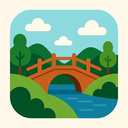
The central element of this icon is a bridge that spans across an expansive natural landscape. Unlike conventional bridges designed with rigid symmetry, this structure is intentionally asymmetrical. One side of the bridge curves gently upward into the sky, merging with a canopy of moss-covered trees and vines that spiral outward like living tendrils. The other side descends sharply into a river or stream, where water flows in uneven pulses—some turbulent, some calm—creating ripples that ripple across the surface below. This deliberate imbalance is not an error; it is a design choice reflecting how nature itself operates without strict symmetry. Trees grow in irregular patterns, rivers meander unpredictably, and mountains rise with jagged edges. By mirroring these natural behaviors, the icon speaks to authenticity and organic evolution.
The bridge material itself is composed of natural elements: weathered wood woven with iron vines that have grown into the structure like living roots. These materials are not artificially polished or uniformly shaped; they show signs of time—grime, moss, rust patterns that blend into the texture. The wood appears to have been harvested from ancient forests and reassembled with minimal human interference, suggesting a deep respect for ecological integrity. This use of natural materials reinforces the Nature aspect of the icon, grounding it in reality rather than abstraction. The bridge does not dominate its surroundings; instead, it flows through them like a riverbed or a trail worn by generations of animals and people.
The asymmetry is further emphasized by the spatial composition. On one end, the bridge connects to a high cliff overlooking dense fog-covered valleys where wildflowers bloom in irregular clusters. On the other end, it leads into an open meadow dotted with scattered stones and fallen logs—natural features that have been preserved rather than smoothed or landscaped. The path does not follow a straight line or a balanced midpoint; instead, it angles diagonally across the terrain, creating visual tension that draws the viewer's eye from one side to the other. This dynamic movement reflects how nature encourages exploration and adaptation rather than predictable routes.
The bridge is not just a physical structure; it serves as a metaphorical link between two contrasting ecosystems. One side represents stability—ancient forests with deep roots, enduring soil, and slow growth patterns. The other side represents fluidity—rapidly changing weather, flowing water, and seasonal shifts. The asymmetrical design mirrors the balance between stillness and motion that exists in natural systems. For example, in a forest ecosystem, there is a constant interplay between decomposition (slow) and renewal (fast). This icon captures that rhythm visually—showing how nature thrives on imbalance rather than perfect order.
From a design perspective, the icon’s asymmetry adds visual interest and depth. Traditional bridge icons often appear geometric and repetitive, suggesting artificiality or industrialization. In contrast, this one feels alive and responsive to its environment. The lack of symmetry gives it a sense of movement, unpredictability, and emotional resonance. It invites viewers to pause and observe—not just the form but the story behind it: how humans attempt to connect across vast distances while respecting the natural world’s inherent chaos.
The integration of Nature is not superficial. Every detail—from the moss on the bridge’s surface to the way sunlight filters through leaves and casts shifting shadows—demonstrates a commitment to ecological authenticity. The icon does not depict nature as a backdrop; it is inseparable from the structure itself. The bridge grows with time, its wooden beams slightly warped by wind and moisture, its iron components rusted in places where water collects. These imperfections are celebrated rather than hidden, suggesting that true connection arises from embracing differences and flaws.
Furthermore, the concept of a Bridge here extends beyond physicality. It symbolizes connection—between communities, between cultures, between the human and natural world. The asymmetrical bridge does not offer equal access or uniform conditions on both sides; instead, it acknowledges that each side has unique challenges and resources. This reflects real-world social dynamics where balance is often unattainable, and equity must be negotiated through understanding differences.
Ultimately, this icon is a powerful fusion of Nature, Bridge, and Asymmetrical principles. It challenges traditional design norms that favor symmetry and uniformity by embracing the complexity and beauty found in natural systems. It serves as both an aesthetic object and a philosophical statement—inviting viewers to reconsider what it means to build, connect, and coexist with the environment. In an age of climate change, habitat loss, and environmental degradation, such an icon becomes not just symbolic but necessary—a visual reminder that harmony does not require balance; it requires respect for the wild, the unexpected, and the unstructured.
Therefore, this icon is more than a design—it is a call to action. A call to build with nature in mind, to recognize that asymmetry is not weakness but wisdom. It teaches us that bridges—whether physical or metaphorical—do not need symmetry to be strong; they only need purpose, resilience, and respect for the world they cross.
Create your own icon with our GoGPT AI prompt:
GoGPT