

Nature DNA strand 3D isometric – Free icon download
Download all to grab every PNG variant.
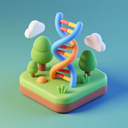
The icon in question is a meticulously crafted visual representation that seamlessly blends three powerful and interconnected concepts—Nature, DNA strand, and 3D isometric design—into a single harmonious artistic statement. This icon transcends mere aesthetic appeal by serving as both a symbolic emblem and a conceptual bridge between biological science and the natural world. It does not simply depict elements; it embodies their essence through an innovative fusion of form, function, and meaning.
At the core of this icon lies the DNA strand, rendered in a clean, precise geometric style that reflects its molecular structure. The DNA helix is not drawn as a simplistic or cartoonish spiral; instead, it is constructed with scientific accuracy—two antiparallel strands twisted into a right-handed double helix, with base pairs clearly visible and spaced to reflect the natural bond angles found in actual DNA molecules. However, rather than appearing flat or two-dimensional, this strand is rendered using 3D isometric projection, which gives it depth and spatial realism. The isometric perspective allows viewers to perceive both the vertical axis of the helix and its horizontal winding motion simultaneously, creating a dynamic sense of movement that mimics how DNA functions in living cells.
The 3D isometric design brings an important layer of sophistication to the piece. In contrast to standard flat illustrations or basic wireframes, this icon uses isometric geometry—a method where all three axes (horizontal, vertical, and depth) are projected at equal angles—so that every element appears in three dimensions without distortion. This technique creates a sense of volume and realism that makes the DNA strand feel tangible, almost like a physical structure one could touch or hold. The result is not only visually striking but also intellectually engaging: viewers immediately recognize the molecular structure while simultaneously being drawn into the spatial depth of the image.
What sets this icon apart from conventional representations is how it integrates Nature as a central theme. Rather than treating DNA as an isolated scientific object, the icon weaves natural elements throughout its design. For instance, subtle organic textures are used to outline the edges of the DNA helix—soft gradients that resemble sunlight filtering through leaves or soil patterns beneath trees. These textures suggest growth, continuity, and evolution—hallmarks of natural systems. In some versions of the icon, faint lines resembling tree branches or riverbeds appear in the background as abstract extensions from the DNA strands, symbolizing how life forms emerge and interconnect across ecosystems.
The integration of nature extends beyond visual motifs. The color palette is carefully selected to reflect natural environments: deep greens for foliage, earthy browns for soil and rock formations, soft blues for water features, and gentle purples that evoke twilight or the colors found in flowers. These hues are not arbitrarily chosen—they are grounded in natural phenomena and biological processes. For example, green is associated with chlorophyll and photosynthesis; blue reflects the coolness of water bodies essential to life; brown suggests stability and the foundation of ecosystems. This palette reinforces the idea that DNA is not merely a genetic code stored within cells, but part of a vast, interwoven network that sustains all forms of life in nature.
The 3D isometric format further amplifies this connection to nature by allowing viewers to perceive how biological structures exist in three-dimensional space—just as organisms grow and interact with their surroundings. In the real world, plants grow upward toward light, animals move through environments shaped by terrain and climate, and ecosystems function in dynamic balance. The isometric rendering of the DNA strand mirrors this complexity: it appears not just as a static molecule but as an active participant in a living system. It suggests that genetic information does not exist in isolation—it flows through cells, organisms, and generations like water through rivers or light through forests.
This icon is particularly effective in educational and scientific communication contexts. It can be used in biology classrooms, environmental science presentations, or public awareness campaigns about biodiversity and genetic heritage. The 3D isometric style makes it accessible to audiences unfamiliar with molecular biology—visually intuitive without sacrificing scientific accuracy. At the same time, its nature-inspired elements invite emotional connection; viewers may feel a sense of awe or reverence when they see how life’s blueprint is intricately tied to the natural world.
Moreover, from a design standpoint, this icon exemplifies modern trends in visual communication that blend science with environmental consciousness. In an age where sustainability and ecological awareness are increasingly important, such an emblem serves as a reminder that human knowledge—especially in biology—is deeply rooted in nature. The DNA strand here is not just a scientific curiosity; it's a symbol of life’s resilience, diversity, and interconnectedness.
In conclusion, the icon combining Nature, DNA strand, and 3D isometric design represents more than a visual artifact—it is a philosophical statement about the relationship between science and the natural world. It demonstrates that understanding life at its most fundamental level does not require abstract thinking or complex equations; instead, it can be conveyed through elegant forms that resonate with both intellect and emotion. By using 3D isometric perspective to bring depth and realism to the DNA helix, and by embedding natural elements throughout its composition, this icon becomes a powerful visual metaphor for life's intricate balance—where every strand of genetic code is part of a larger, living tapestry woven from sunlight, water, soil, and time.
For designers, educators, and environmental advocates alike, this icon stands as a testament to the beauty that emerges when science meets nature through thoughtful visual storytelling. It is not merely beautiful—it is meaningful. And in that meaning lies its lasting value.
Create your own icon with our GoGPT AI prompt:
GoGPT