

Nature DNA strand Digital glitch – Free icon download
Download all to grab every PNG variant.
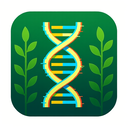
The icon in question is a dynamic, visually striking fusion of three profoundly contrasting yet deeply interconnected elements—Nature, DNA strand, and Digital Glitch—creating a unique visual metaphor that speaks to the intersection of biological existence and technological evolution. This icon does not merely combine these concepts; it weaves them into a living narrative that reflects the complexity and duality of our world today.
At its core lies the Nature motif, represented through flowing, organic forms reminiscent of rivers, trees, or forest canopies. The natural elements are not static—they pulse gently with motion and life. Branches resembling tree roots or vines emerge from the base of the icon, curling upward in a spiral that mimics growth patterns found in ecosystems. These natural lines are rendered with soft gradients—emerald greens blending into deep mossy browns and twilight blues—evoking sunlight filtering through leaves or mist rising from a forest floor. The presence of Nature here is not decorative; it symbolizes the foundational origins of life, balance, and cyclical patterns that have existed for eons. It grounds the entire icon in a sense of timelessness, reminding viewers that all technological progress stems from natural processes—photosynthesis, evolution, biodiversity.
Interwoven into this organic framework is the DNA strand, which functions not just as a literal structure but as an evolving narrative thread. The DNA helix is not placed in isolation; instead, it appears to grow organically from the natural elements—its double helix curling around tree roots or ascending through leaf veins. Each base pair (A-T, C-G) is subtly animated with digital pulses that shift colors slightly between blue and purple as if reacting to an external signal. The DNA strand is not rigid; it bends and twists in ways that echo the fluidity of natural movement. At certain points along the helix, micro-ripples appear—like waves in a lake—suggesting the dynamic nature of genetic expression, mutation, and adaptation. This representation highlights how life at its most fundamental level operates through coded information that governs form and function.
Yet what makes this icon truly transformative is the integration of Digital Glitch. The digital element does not serve as a disruptive overlay but rather as a symbiotic force, enhancing the visual tension between organic and artificial. Periodic bursts of digital noise—static lines, pixelated fragments, and color shifts—appear along the DNA strands and natural forms. These glitches are not random errors; they follow patterns that resemble binary sequences or data transmission errors. For instance, when a segment of the DNA helix is exposed to glitch effects, it briefly fractures into jagged digital fragments before reforming with a slightly altered sequence, suggesting mutation through technological interference or artificial intelligence intervention.
The digital glitches do not destroy the natural form—they interact with it in a way that suggests coexistence and evolution. In one area, a vine might momentarily dissolve into pixels before reconstituting as a glowing wire-like structure, symbolizing how technology can both disrupt and reshape biological systems. In another section, sunlight filtering through leaves becomes fragmented into digital noise—each fragment briefly displaying hexadecimal code such as “0x5A3F” or “110010,” implying that nature is being translated into data. This moment reflects the growing reality in which environmental monitoring, bioinformatics, and AI-driven ecological modeling are turning the natural world into datasets.
This icon thus becomes a commentary on our contemporary relationship with both nature and technology. It illustrates how modern science—particularly in fields like synthetic biology and genetic engineering—is blurring the lines between natural processes and digital manipulation. The DNA strand, once confined to a laboratory, now exists in the wild, potentially influenced by digital tools that analyze or even alter gene expression. At the same time, nature itself is becoming increasingly visible through digital sensors and algorithms—forest fires mapped via satellite imagery, climate data visualized in real time.
The interplay between these three elements creates a sense of paradox and beauty. The natural world appears both vulnerable and resilient, constantly being read, interpreted, and altered by digital systems. Yet within this transformation lies a profound resilience—the glitches do not erase nature; they reveal it in new ways. The icon suggests that even in the face of technological disruption, nature persists through adaptation—just as DNA evolves through mutation.
Furthermore, this icon serves as a visual metaphor for human consciousness and identity. We are made from DNA—our biological blueprint—and we are also deeply embedded in digital environments where our thoughts, emotions, and behaviors are being recorded and analyzed. The glitch represents both the imperfections of technology and the uncertainty of interpretation. But within that chaos, there is structure—the natural flow of life continues to emerge through the very patterns disrupted by digital noise.
From an aesthetic standpoint, the icon balances complexity with harmony. The colors are rich yet controlled—deep greens for nature, cool purples for DNA sequences, and sharp whites or electric blues for the digital glitches. The composition is dynamic but not chaotic: each element flows into the next in a rhythmic pattern that mimics natural growth cycles or biological rhythms like circadian patterns.
In conclusion, this icon—fusing Nature, DNA strand, and Digital Glitch—is more than a visual design; it is a philosophical statement about the future of life on Earth. It reminds us that nature is not static or separate from technology—it is deeply interconnected with digital systems that monitor, interpret, and sometimes manipulate it. The DNA strand serves as the bridge between biology and data, while the glitch acts as both a warning and an invitation—a reminder of our responsibility to preserve natural integrity even as we advance technologically.
Ultimately, this icon stands as a symbol of balance: one that celebrates life’s complexity while acknowledging our growing role in shaping its future through science and innovation. It is both awe-inspiring and sobering—an image that encourages viewers to reflect on how deeply the natural world, human biology, and digital technology are interwoven in the story of our time.
Create your own icon with our GoGPT AI prompt:
GoGPT