

Nature Globe Pixel art – Free icon download
Download all to grab every PNG variant.
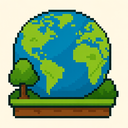
At the heart of modern digital design lies a profound balance between the natural world and the structured realm of technology. This iconic representation — a seamless fusion of Nature, Globe, and Pixel art — embodies not only aesthetic innovation but also deep symbolic meaning. It transcends mere visual appeal to serve as a visual metaphor for humanity's relationship with the planet, mediated through the lens of digital expression. The icon is crafted as a dynamic, vibrant image where each element — nature’s organic forms, the global scale of our world, and the crisp clarity of pixel-based design — interacts in harmony to tell a story that speaks to both environmental awareness and technological progress.
The foundation of this icon rests upon Nature, which is not merely an ornamental detail but a central thematic force. In the composition, nature manifests through stylized, hand-painted textures rendered in pixel art form — such as branching trees with angular yet expressive leaf patterns, flowing rivers that follow the grid lines of pixels like digital ripples, and mountain ranges defined by sharp edges and gentle gradients. These natural elements are not photorealistic; instead, they are distilled into a simplified aesthetic where each pixel serves as a deliberate brushstroke of digital artistry. The trees do not grow in perfect symmetry but appear organic and alive, with irregular growth patterns that mirror the unpredictability of real ecosystems. Flowers bloom in clusters, their petals composed of carefully placed pixel blocks that suggest color and depth without relying on complex shading — a hallmark of pixel art's limited yet expressive language.
Integrated within this natural framework is the Globe, representing both geographical awareness and global interconnectedness. The globe is not a smooth, seamless sphere as one might see in traditional illustrations. Instead, it is constructed using the same pixelated style — each continent and ocean rendered with distinct, blocky outlines and flat colors that echo digital cartography. The Earth’s surface features subtle gradients where pixels transition from green (forests) to blue (oceans), and tan or brown (deserts), all within a tightly controlled pixel grid. The globe is subtly rotated to suggest motion — not just spatial movement but also a sense of continuity, as if the planet is breathing and evolving over time. Each major landmass appears as a geometric shape with gentle curves, reflecting how nature can be both chaotic and structured at the same time.
Crucially, the icon leverages Pixel art not just as a stylistic choice but as a philosophical statement. Pixel art has long been associated with retro gaming and early computing — an aesthetic born from technological limitations. In this modern interpretation, pixel art becomes a vessel for environmental storytelling. It is not about nostalgia; it is about intentionality. Every pixel contributes to the narrative: the way sunlight hits a tree in one corner of the image, or how wind might ripple across a digital river’s surface — all conveyed through color transitions and spacing. The palette uses earth tones — greens, browns, blues and soft yellows — reminiscent of natural landscapes while maintaining high contrast for visibility on digital screens. This deliberate use of limited colors ensures that even on small devices or low-resolution displays, the icon remains legible and meaningful.
The interplay between nature and globe is what gives the icon its depth. For instance, a forest in northern Canada is rendered with crisp pixel blocks, while a desert in Africa appears as wide open spaces of warm sand-colored pixels. A river flows from north to south across the globe’s surface, merging into an ocean on the far side — all defined by straight lines and consistent pixel alignment. This structure reflects both the precision of digital design and the unpredictability of natural systems. The icon subtly suggests a dialogue between humanity and nature: we may live in a globalized, technology-driven world, yet our roots remain deeply embedded in natural systems.
Moreover, this icon functions as a visual symbol for sustainability. It calls attention to how human activity affects the planet — through changes in land use, climate patterns, and biodiversity — all of which are hinted at by variations in pixel density and color. For example, a region with overgrown pixels might represent deforestation; areas with lush green clusters suggest reforestation efforts or conservation zones. The pixel art style allows for these messages to be communicated clearly without becoming overly complex or abstract.
The icon is also accessible across various platforms and devices — from mobile apps to web dashboards — precisely because of its reliance on pixel art. It remains visually consistent whether viewed on a large monitor or a small tablet screen. The simplicity of the design ensures that it can be easily recognized and understood by diverse audiences, from children to professionals in environmental sciences.
Ultimately, this icon is more than a visual motif; it is a digital language that connects the natural world with our technological age. It celebrates both the beauty of nature and the ingenuity of pixel-based design. By merging Nature with Globe and embracing the expressive potential of Pixel art, it becomes a timeless symbol of balance, awareness, and hope — reminding us that even in a digital age, our connection to the Earth remains both essential and deeply rooted.
In sum: This icon is a tribute to nature's resilience, the planet's global unity, and the enduring power of pixel art as a medium for storytelling. It is not just beautiful — it is meaningful.Create your own icon with our GoGPT AI prompt:
GoGPT