

Nature Globe Retro – Free icon download
Download all to grab every PNG variant.
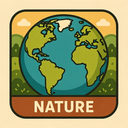
At the intersection of ecological awareness, global consciousness, and nostalgic design lies a truly unique icon — one that masterfully fuses the timeless essence of Nature, the expansive reach of a Globe, and the aesthetic charm of Retro design. This icon transcends mere visual representation; it embodies a philosophy — one that celebrates our planet's natural beauty, acknowledges humanity’s interconnected existence across continents, and pays homage to the design sensibilities of bygone eras. It is not just an image; it is a narrative woven into pixels and form.
Central to this icon is the concept of Nature. The visual core features lush green foliage rendered in a soft, organic texture — reminiscent of ancient forests, meadows under dappled sunlight, or misty mountain peaks. These elements are not abstract; they are deeply rooted in real-world ecosystems. Instead of flat colors, the leaves and branches feature subtle gradients that mimic the way sunlight filters through trees — warm amber at dawn transitioning to cool blues at twilight. The nature motifs grow organically from a central base, forming an interwoven network that suggests harmony between living systems and their environment. Each leaf bears a faint pattern resembling natural cellular structures, echoing the intricate beauty found in biology and botany. This attention to detail reflects an understanding that true nature is complex, layered, and alive — not just a static background.
Surrounding this natural core is the Globe, rendered not as a standard cartographic sphere but as a retro-futuristic mosaic. The globe appears slightly tilted, as if viewed from above the Earth’s atmosphere, with distinct continents outlined in smooth, hand-drawn lines reminiscent of vintage maps from the 1960s or 70s. Each continent is subtly colored using earth tones — terracotta for Africa, deep teal for Europe, rust orange for Asia — evoking not just geographic boundaries but cultural and ecological diversity. The globe is slightly transparent, allowing the natural elements beneath to gently bleed through — a visual metaphor suggesting that nature transcends political borders and that ecosystems are interdependent. In places where oceans meet landmasses, waves ripple in retro-style waveforms, echoing vintage analog signals or old television broadcasts. This blend of geographic realism with artistic stylization reinforces the idea that our planet is both vast and intimately connected to its natural rhythms.
Where this icon truly stands out is in its Retro aesthetic. Drawing inspiration from mid-20th-century design — particularly 1970s and early 1980s graphic art, analog technology, and space-age visuals — the icon employs a clean, minimalist style with bold outlines and a slightly softened edge treatment. The lines are not sharp but gently curved, mimicking the look of vintage typography or old-school circuit boards. The colors are limited to warm earth tones and muted pastels — think dusty rose, sage green, faded blue — avoiding high saturation that might feel modern or digital. Instead, there’s a deliberate use of negative space and symmetry to evoke a sense of simplicity and nostalgia. The retro elements are not merely decorative; they serve a deeper purpose: they create emotional resonance with users who remember the analog world — where televisions had glowing screens, maps were hand-drawn, and nature was often celebrated in black-and-white illustrations.
This blend of Nature, Globe, and Retro is not random. It tells a story about the human relationship with the Earth. The natural elements represent our responsibility to preserve biodiversity, protect forests, and live in balance with ecosystems. The globe represents global awareness — that environmental issues do not respect national boundaries, from climate change to deforestation to pollution. And the retro design speaks directly to generational memory: it reminds us that sustainability was once a core value in design and culture — something lost as digital aesthetics took over. By returning to retro styles, the icon suggests a call for reflection and rebirth — for humanity to rediscover its roots in nature while embracing global responsibility.
Furthermore, this icon is designed with accessibility and inclusivity in mind. It avoids symbols that might be culturally biased or environmentally misleading. The use of natural patterns ensures it can be understood by people from diverse backgrounds — no need for language or specific cultural knowledge to interpret the message of harmony, balance, and care for our planet. Its retro style also makes it instantly recognizable across digital platforms — whether on a mobile app icon, a website footer, or educational material — because people are familiar with such visual styles.
In essence, this icon is more than a graphic element; it is a bridge between the past and the future, between human imagination and ecological reality. It stands as a silent reminder that our planet is alive, interconnected, and rich in beauty — beauty that has always existed but has been obscured by industrialization and digital detachment. The retro design does not simply pay tribute to the past; it invites us to look back with wonder and forward with intention. By integrating nature’s authenticity, the globe’s global scope, and retro design’s emotional warmth, this icon becomes a symbol of hope — one that inspires action, awareness, and respect for our shared home.
In a world increasingly dominated by artificial intelligence and digital abstraction, this icon offers a grounded alternative — reminding us that true progress is not measured in speed or data but in balance, beauty, and connection to the natural world we all inherit.
Create your own icon with our GoGPT AI prompt:
GoGPT