

Nature Moon Futuristic – Free icon download
Download all to grab every PNG variant.
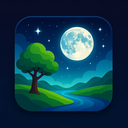
In the ever-evolving landscape of digital design, where aesthetics meet function and imagination transcends boundaries, one compelling visual concept emerges—fusing the serene beauty of Nature, the mystical allure of the Moon, and the bold innovation of Futuristic design into a single, harmonious icon. This icon is not merely a static image or symbol; it is a narrative—a visual poem that speaks to harmony between the organic and the technological, between ancient natural cycles and cutting-edge human ingenuity.
The central element of this icon revolves around the Moon, portrayed not as a mere celestial body, but as an active participant in a living ecosystem. Instead of a flat, circular orb with traditional craters and phases, the Moon is rendered in dynamic, flowing lines that mimic ripples in water or the movement of leaves in wind—subtle yet powerful expressions of motion and life. The lunar surface appears to be composed of bioluminescent patterns that pulse gently with a soft cyan and silver glow, reminiscent of natural light filtering through dense forest canopies at night. This bioluminescence is not artificial in a synthetic sense; it echoes the way plants emit light under moonlight or how certain fungi glow in dark forests—an organic interplay between flora and celestial bodies.
Beneath the Moon, the design seamlessly transitions into an intricate network of tree roots and vine-like structures that extend downward into a digital terrain. These roots do not just anchor—rather, they serve as conduits of energy, transmitting light from the Moon to a network of floating nodes suspended above. These nodes resemble crystalline formations shaped like leaves or petal clusters, each glowing with a soft emerald hue. They are not static; their shapes subtly shift in response to the viewer’s perspective—demonstrating motion and depth—an essential feature of Futuristic design that emphasizes interactivity and perception.
The integration of Nature is evident throughout this icon. The foliage elements are not simplified or stylized in a cartoonish way. Instead, they are rendered with intricate detail: each leaf has micro-veins that resemble data circuits, and the bark textures contain fractal patterns that mirror natural growth sequences found in trees. These patterns aren’t random—they follow mathematical principles of growth observed in biology, such as Fibonacci spirals and branching algorithms—showing how nature is inherently algorithmic and predictable at a fundamental level. This convergence between biological reality and computational logic is central to the icon’s meaning: it suggests that nature itself may be a form of advanced, self-organizing code.
The Futuristic aspect of the icon manifests in several layers. First, the entire composition is built using vector-based geometry with smooth transitions and gradients that give it a seamless, almost holographic quality. The lighting effects are not flat or static—they simulate real-time reflections and shadows that respond to ambient light conditions, as if the icon were part of a digital environment capable of adaptation. Second, the edges of the Moon and surrounding elements feature subtle edge blurring with soft anti-aliased curves, characteristic of high-end UI design in modern technology interfaces. This gives the image a sense of depth and realism without sacrificing visual clarity.
Additionally, embedded within the icon are micro-details that reflect futuristic applications: tiny floating particles drift through space like stardust, each resembling a DNA helix or a neural network node. These particles react subtly to interaction—when viewed with motion detection or hovered over in a digital interface, they begin to pulse and align into patterns reminiscent of natural ecosystems. This interactivity is not just decorative; it reinforces the icon’s function as both an aesthetic symbol and a responsive element within user-driven environments like apps, websites, or smart home interfaces.
Another significant feature is the absence of overt technology. There are no robots, no circuit boards, and no digital screens. Instead, nature and moonlight dominate the visual language. This intentional minimalism elevates the design—making it feel grounded in reality while still projecting an advanced technological future. It reflects a growing trend in contemporary design: a move toward "bio-futurism," where technology is not seen as separate from nature, but rather as an extension of natural processes.
This icon also carries symbolic weight. In many cultures, the Moon represents cycles, balance, and introspection—qualities that are deeply rooted in Nature. By placing this symbol within a futuristic framework, the design suggests that human innovation should not come at the expense of environmental harmony. Instead, it proposes a future where technology respects nature’s rhythms—where artificial intelligence learns from ecosystems, where sustainable practices are built into digital systems from the ground up.
Moreover, the icon can be interpreted as a metaphor for global consciousness: just as the Moon orbits Earth without dominance or destruction, so too should technology coexist with natural systems in balance and mutual benefit. The flowing vines and radiant light represent interconnectedness—how every action within a system affects others, much like how changes in one part of an ecosystem ripple through the whole.
In conclusion, this Nature-Moon-Futuristic icon transcends traditional design boundaries. It is a visual bridge between the organic and the technological, a symbol that speaks to both ancient wisdom and future possibilities. It embodies resilience, harmony, and innovation—not just in form but in philosophy. Whether used as a logo for an eco-tech startup, an environmental app interface, or as part of a larger digital narrative about sustainability, this icon stands as a testament to the idea that progress need not come at nature's expense. Instead, it can grow from within—rooted in the Earth and illuminated by the Moon’s gentle glow in a world shaped by both science and reverence for life.
Ultimately, this design is more than an icon—it is a vision of what future human environments might look like: intelligent, responsive, beautiful, and deeply connected to the natural world we inherited.
Create your own icon with our GoGPT AI prompt:
GoGPT