

Nature Moon Origami – Free icon download
Download all to grab every PNG variant.
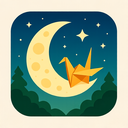
The "Nature, Moon, and Origami" icon is a harmonious fusion of organic natural elements, celestial elegance, and the precision artistry of paper folding. This intricate visual symbol transcends mere aesthetic appeal; it embodies a deep philosophical connection between the earth's rhythms, the quiet beauty of the cosmos, and human creativity through traditional craftsmanship. Designed with intention and sensitivity to each element, this icon serves as both a visual meditation and a narrative gateway into themes of balance, transformation, and interdependence.
At its core lies Nature, which is not only present in the icon’s form but also defines its spirit. The icon features flowing organic shapes reminiscent of trees, rivers, and wind-swept grasses—silhouettes that appear both ancient and alive. These natural forms are not rigid or mechanical; instead, they possess a gentle fluidity, as if breathing with the rhythm of the seasons. Leaves curl gently into paper-like folds that mirror the way foliage responds to sunlight and rain. The base of the design is rooted in earthy tones—deep greens, warm browns, and soft mosses—that evoke soil fertility and biodiversity. This grounding in nature emphasizes sustainability, growth, and resilience—qualities essential to both ecological health and personal well-being.
Interwoven with the natural elements is the luminous presence of the Moon. The moon does not dominate the composition but rather floats gently above a field of folded paper forms, casting a soft silver glow across the scene. Its light is not harsh or artificial; it is diffused and ethereal, illuminating creases and edges with a quiet radiance that suggests calm, introspection, and guidance. The moon is depicted in subtle phases—perhaps waning or waxing—indicating cycles of change and renewal. It appears as a crescent suspended between two folded paper blossoms, symbolizing the interplay between silence (the moon’s stillness) and growth (the unfolding of nature). This celestial presence reminds viewers of the importance of rhythm in life: just as tides follow natural patterns, so too should human activities align with environmental and emotional cycles.
Central to this icon is Origami, a Japanese art form that transforms flat paper into three-dimensional figures through precise folding. In this design, origami is not merely decorative—it acts as the structural bridge between nature and the moon. The paper itself is composed of layered, translucent sheets that resemble petals or leaves, each fold representing a moment of intention and care. The folded forms are not random; they follow a symbolic sequence—each crease echoing natural patterns such as tree branches, river meanders, or spiral shells. One particularly striking element is the central origami crane that rises upward from the ground like a bird taking flight at night, its wings gently open to catch the moonlight. This crane is folded with such care and precision that it appears almost alive—its lines are clean but not cold, balanced between rigidity and grace.
The interaction between origami and nature is profound. The folded paper acts as a vessel for natural energy; each fold captures a moment from the natural world—like how leaves grow in spirals or how water flows through rock formations. These folds are not arbitrary; they reflect principles found in fractal geometry, growth patterns, and the Fibonacci sequence—all of which are naturally occurring. Thus, the origami elements serve as an artistic translation of nature’s underlying order into human design. This fusion encourages viewers to see paper not as a passive material but as a living medium that can express both simplicity and complexity.
Furthermore, the moonlight shining through the origami forms creates a magical interplay of light and shadow. The folds catch and reflect the moon’s glow, creating soft halos around each crease—like nature itself is illuminated from within. This phenomenon symbolizes enlightenment: just as paper becomes more meaningful when folded into shape, so too does life gain depth through intentionality and mindfulness. The moon’s light also acts as a metaphor for inner clarity—a guiding force that helps us navigate life’s challenges, much like how nature provides balance in the face of change.
The icon is not only visually compelling but also philosophically rich. It suggests that human creativity—embodied in origami—can coexist with and honor natural systems. In a world increasingly dominated by industrialization and digitalization, this icon serves as a reminder to slow down, observe closely, and reconnect with the earth. The careful folding of paper mirrors the way we shape our lives through reflection, patience, and deliberate choices. It speaks to mindfulness in action—how even small gestures of care (like folding a single piece of paper) can have lasting effects.
Additionally, this icon holds cultural significance. Origami is deeply rooted in Japanese tradition, which values harmony with nature and the universe—a philosophy known as wabi-sabi. The moon is a recurring symbol in Shinto and Buddhist traditions, representing stillness, reflection, and spiritual connection. By combining these elements with a naturalistic aesthetic, the icon becomes a cultural touchstone that bridges Eastern philosophies with universal human experiences.
It is important to note that this icon is not static. It invites viewers to engage through imagination—what if the paper blooms into flowers at dawn? What if the moon slowly rises higher each time it is observed? The design encourages a dynamic relationship between observer and image, transforming passive viewing into an active meditation.
In conclusion, the "Nature, Moon, and Origami" icon is more than a visual piece—it is a living metaphor. It embodies balance between the organic world and human creativity, between the quiet power of the cosmos and the delicate art of folding paper. Through its intricate blend of nature’s grace, moonlight’s serenity, and origami’s precision, it inspires contemplation on sustainability, mindfulness, beauty in simplicity, and our shared responsibility to care for Earth. This icon stands as a tribute to harmony—an enduring symbol that reminds us we are part of something greater: a universe that flows with rhythm, unfolds with intention, and glows with quiet light.
Create your own icon with our GoGPT AI prompt:
GoGPT