

Nature Road Pixel art – Free icon download
Download all to grab every PNG variant.
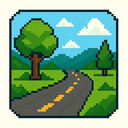
At the intersection of serenity, movement, and digital simplicity lies a unique and visually compelling icon that beautifully synthesizes three distinct yet harmonious elements: Nature, Road, and Pixel Art. This icon is not merely a static image but an evocative visual narrative crafted with intention—each line, color gradient, and shape reflecting both the organic rhythms of the natural world and the structured clarity of digital design. The fusion of these three keywords creates a rich tapestry that speaks to human connection with the environment, sustainable travel, and modern digital aesthetics.
Firstly, Nature is not just a backdrop but a central theme in this icon. It is portrayed through stylized representations of trees, hills, mountains, rivers flowing gently across the landscape, and soft clouds drifting above. These natural elements are rendered with attention to detail yet simplified into clean forms that maintain an unmistakable sense of life and growth. The tree branches emerge as branching pixelated structures resembling the roots of digital forests—each leaf a carefully placed pixel that suggests movement and breathing. The hills are not just geometric shapes; they mimic real topography, with gradual slopes and gentle curves, evoking the feeling of walking through a rural countryside during sunrise or twilight. The rivers are depicted as flowing lines made up of alternating pixel blocks, mimicking water's natural flow while maintaining digital precision.
The inclusion of Road serves as both a pathway and a metaphor for human journeys—both literal and symbolic. A well-defined road winds through the center of the composition, starting from a modest dirt path at the bottom left, gradually ascending into a winding highway that connects to distant mountain passes. This road is not rendered with realism; instead, it follows classic pixel art principles where lines are sharp, edges are crisp, and every segment has clear boundaries. The road surface alternates between gravel texture and smooth asphalt—both represented using simple color blocks (e.g., brown for gravel, gray for concrete). Road signs appear in the distance as tiny pixelated rectangles with bold text: “Sustainable Route” or “Forest Path,” subtly reinforcing the theme of responsible travel within nature.
The visual style of this icon is rooted in Pixel art, a design form that originated from early video game technology and continues to influence modern digital culture. Every element—trees, road, sky, even the horizon—is constructed using a grid-based system where each pixel is a square block of color. This gives the entire composition an unmistakable retro charm while maintaining clarity and visual appeal at any screen size. The color palette is intentionally limited to earth tones: greens (from forest to moss), browns (dirt, soil), blues (sky and water), and grays (road surface). These colors not only reflect natural environments but also support the pixel art aesthetic by avoiding overly saturated or modern digital hues.
The composition itself follows a balanced layout. The viewer’s eye is naturally drawn to the road, which acts as a visual axis of motion—guiding attention from left to right and from near to far. At each turning point along the road, small pixelated details emerge: a bird perched on a branch, an animal silhouette in the distance (like a deer or fox), or even windblown grass waves that ripple across the terrain. These tiny elements are not only decorative but serve to deepen the sense of life within nature—proving that even in a stylized format, biodiversity and ecological awareness can be communicated effectively.
What makes this icon stand out is how seamlessly it integrates all three elements without compromise. The pixel art style does not sacrifice authenticity; rather, it enhances it by emphasizing textures and patterns that would otherwise be lost in high-resolution realism. For instance, the texture of bark on a tree is represented as a mosaic of small, repeated square blocks—each one slightly varied to suggest natural variation. Similarly, the road’s surface shows wear and tear through subtle pixel shifts: cracks appear as broken lines between blocks, and shadows are cast using darkened pixels to give depth.
Moreover, this icon functions not only as a visual piece but also as a symbol of purpose. It represents a growing movement toward environmentally conscious travel—where roads are designed to minimize ecological disruption, where transportation paths support biodiversity, and where digital interfaces celebrate the beauty of natural landscapes. In an era dominated by urbanization and digital abstraction, this icon serves as a gentle reminder that technology can harmonize with nature rather than dominate it.
The pixel art style also makes the icon highly accessible. It scales beautifully across different devices—from smartphones to tablets to large displays—without losing its integrity. This scalability is essential in today’s digital world, where icons must be easily recognizable regardless of screen resolution or context. The use of bold contrasts and simple shapes ensures that even on low-resolution screens, the core message remains clear: nature and movement are connected through thoughtful design.
Additionally, this icon can be adapted for various applications. It could serve as a navigation app's interface element—guiding users through eco-friendly routes in forested regions. It might appear on environmental education platforms to teach children about sustainable transportation and land use. Or it could be used in urban planning tools to visualize proposed green corridors or nature trails.
In conclusion, the “Nature, Road, and Pixel Art” icon is more than a decorative motif—it is a thoughtful synthesis of three powerful ideas. It honors the quiet beauty of natural landscapes through stylized forms, celebrates human movement through well-planned pathways, and embraces digital simplicity through the timeless elegance of pixel art. This icon stands as a testament to how design can bridge the gap between technology and ecology, offering both aesthetic appeal and meaningful symbolism in a world increasingly shaped by innovation.
By merging the organic flow of nature with the structured progression of roads and the nostalgic clarity of pixel art, this icon invites viewers not just to look—but to reflect. It encourages a deeper appreciation for our natural environments and reminds us that progress can be both sustainable and beautiful. In every pixel, there is a whisper of earth; in every road segment, a promise of connection; and in the whole composition—a vision of harmony between man and nature.
Create your own icon with our GoGPT AI prompt:
GoGPT