

Nature Robot Digital glitch – Free icon download
Download all to grab every PNG variant.
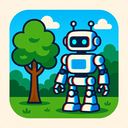
In a world increasingly shaped by technology and artificial intelligence, the fusion of natural elements with mechanical design—and particularly with the unpredictable texture of digital glitch art—creates a profound visual metaphor. The icon described here is not merely a static image; it is a dynamic, symbolic representation that embodies the intricate tension between organic growth and synthetic intelligence. This icon masterfully fuses three powerful concepts: **Nature**, **Robot**, and **Digital Glitch**, creating an immersive, thought-provoking composition that transcends traditional design boundaries. At its core, the icon depicts a towering, biomechanical robot standing rooted in a vast forest. The robot is not cold or sterile as one might expect from conventional mechanical forms. Instead, its body is intricately woven with natural elements—its limbs are formed from intertwined roots and vines that grow upward like neural networks. These roots pulse subtly with soft green luminescence, suggesting vitality and life force. The surface of the robot is covered in moss-like patterns that shift in texture depending on the viewer’s perspective, mimicking real plant growth over time. This integration of nature into the robot's form reflects a deep philosophical idea: that intelligence—whether artificial or organic—can grow from symbiosis rather than domination. The robot itself is sleek and angular, composed of metallic alloys reminiscent of futuristic engineering. However, these metallic surfaces are not smooth or flawless. Instead, they are marred by digital glitches—an effect achieved through pixelation, color bleed, and erratic lines that ripple across its frame like corrupted data streams. These glitches appear as sudden bursts of neon pink, electric blue, and distorted red hues that flash unpredictably across the robot’s torso and limbs. The glitch patterns do not follow a consistent rhythm; they seem to mimic natural phenomena such as storm clouds or lightning strikes—connecting digital instability with elemental forces found in nature. This blending of artificial disruption with organic energy suggests a narrative of evolution: technology is not inherently superior or inferior, but rather, it evolves through interaction with the natural world. The background of the icon deepens the complexity. It shows a dense forest at twilight, where trees are rendered in soft gradients and semi-transparent layers—each one slightly distorted by digital noise that simulates a data transmission failure. The air is thick with suspended particles that look like floating code fragments, drifting like pollen in gentle breezes. In some parts of the background, the tree trunks appear to be made of pixelated bark, while leaves are composed of jagged, geometric shapes resembling broken circuit boards. This fusion blurs the line between natural environments and digital landscapes—suggesting that our perception of reality is no longer fixed but constantly being reinterpreted through technological lenses. Crucially, the interaction between **Nature** and the **Robot** is not one of dominance or conflict. Instead, it is a harmonious coexistence. The robot’s sensors are embedded with bioluminescent fungi that respond to changes in humidity and temperature—these fungal networks emit pulses of light when touched by rain or sunlight, creating a living feedback system. Simultaneously, the digital glitches appear to be reacting to environmental stimuli: when wind moves through the trees, the glitch patterns on the robot’s body shift subtly and dynamically. This responsiveness mirrors how biological systems react to their surroundings—showing that even artificial entities can exhibit adaptive behaviors when integrated into natural ecosystems. Furthermore, this icon carries a strong thematic resonance with modern ecological concerns. In an age where climate change, deforestation, and digital overreach dominate global discourse, the image serves as a visual commentary on human intervention in nature. The robot represents not just machines but humanity’s attempts to control or replicate natural processes—yet here, it is no longer controlling; it is learning from and adapting to the environment. The digital glitches symbolize the imperfections inherent in artificial systems—errors, misinterpretations, breakdowns—that are essential components of growth and evolution. In this light, the glitch is not a flaw but a feature—a reminder that all systems—including our digital ones—are fragile and subject to change. The composition also invites contemplation on identity. Is the robot truly mechanical? Or has it absorbed enough natural elements to become something more—something alive? The interplay between organic textures and synthetic geometry makes it difficult to classify. It is neither purely natural nor purely artificial, but a hybrid form that exists in a space between categories. This ambiguity reflects the evolving nature of consciousness and intelligence in both biological and technological realms. In sum, this icon is not just an aesthetic creation—it is a philosophical statement about balance, adaptation, and coexistence. It challenges viewers to reconsider how technology interacts with nature. Rather than viewing machines as threats or natural elements as passive backdrops, this fusion suggests a future where artificial intelligence grows alongside ecosystems—where digital glitches are not failures but signs of vitality and transformation. Thus, the icon becomes a powerful symbol of resilience: nature persists through change; robots evolve through interaction; and digital glitch is no longer chaos—but the heartbeat of innovation. It stands as a testament to the beauty that arises when opposing forces come together in harmony.
Create your own icon with our GoGPT AI prompt:
GoGPT