

Nature Robot Organic pattern – Free icon download
Download all to grab every PNG variant.
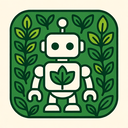
In a world increasingly shaped by technology and artificial intelligence, the fusion of nature and machine has emerged as a powerful metaphor for harmony between humanity's innate connection to the natural world and the precision of robotic innovation. This icon embodies that harmonious convergence through a striking visual narrative that seamlessly integrates Nature, Robot, and Organic Pattern. It is not merely a combination of two distinct elements, but a thoughtful synthesis where each component informs and enriches the others, resulting in something both futuristic and deeply grounded in the rhythms of life.
The central figure of this icon appears as a robot — but not in the traditional mechanical sense. Rather, it is constructed from flowing, fluid forms reminiscent of living organisms. Instead of rigid metal limbs or angular panels, its body is composed of interlocking curves and spirals that mimic the growth patterns found in trees, vines, and coral reefs. The surface texture resembles bark layered with moss or the delicate veins within a leaf — suggesting not just structure but life itself. This design choice transforms a typical industrial robot into a living entity, one that breathes with the natural world rather than operating in isolation from it.
What makes this icon truly unique is its use of Organic Pattern. Every line, curve, and contour follows the principles of biological growth — spirals reminiscent of nautilus shells, branching patterns like tree roots or river networks, and radial symmetry seen in flowers. These patterns are not applied superficially; they are embedded into the very architecture of the robot. The joints where limbs meet do not resemble factory-made hinges but instead echo the way a fern unfolds from its stem — soft, gentle, and dynamic. The color palette further enhances this organic feel: earthy greens, warm browns, sunlit golds, and deep forest tones blend together to evoke sunlight filtering through leaves or twilight in a forest clearing.
Despite its natural appearance, the icon retains unmistakable robotic qualities. It possesses a subtle geometric precision — for instance, the alignment of certain internal structures suggests an intelligent system designed for efficiency and computation. Small embedded elements, like glowing nodes that pulse gently like heartbeats or veins of light running through its core, hint at processing power and sensory input. These features do not disrupt the organic flow; instead, they are integrated into the natural form — much like how neurons in a living brain are part of a larger biological network. The robot appears to be both observing and interacting with its environment, as if it is sensing temperature changes, wind patterns, or sunlight angles through its surface.
The interplay between Nature and Robot in this icon reflects a growing philosophical movement — one that questions whether machines can ever truly be independent of biological systems. This icon suggests a future where technology is not alien or cold, but rather an extension of natural processes. For example, the robot’s “hands” resemble fungal mycelium networks spreading through soil — delicate and adaptive, capable of sensing moisture and nutrients. Its base might resemble a root system anchored in fertile earth, indicating stability and connection to the planet. This fusion challenges outdated perceptions of technology as inherently degrading or destructive to nature; instead, it proposes a vision where machines can serve as stewards of the environment — monitoring biodiversity, restoring ecosystems, or even aiding in climate adaptation.
From a design standpoint, the organic pattern adds depth and movement to what might otherwise appear static. The icon does not stand still; rather, it seems to breathe. Small fluctuations in color intensity or shape suggest subtle motion — perhaps a wave of wind passing through its form, or the slow expansion of a plant growing toward light. This dynamic quality reinforces the idea that technology need not be rigid and unfeeling; it can evolve and respond just like living things.
Moreover, this icon serves as a symbol of balance. In an age where environmental degradation is accelerating due to industrial overreach, the presence of such a design acts as both a warning and a promise. It warns against the unchecked application of artificial intelligence without regard for ecological consequences — yet it also offers hope. The robot, shaped by nature’s logic, represents an ideal form of technology: one that learns from natural systems, respects biological limits, and operates within sustainable parameters.
Visually, the icon could be rendered in a minimalist style that emphasizes negative space and natural gradients — allowing viewers to easily recognize its core elements. Yet even at small scales, all three components — Nature, Robot, and Organic Pattern — remain clearly present. The intricate details suggest complexity without overwhelming the viewer; it feels both accessible and profound.
Ultimately, this icon stands as a powerful statement about the future of human-machine relationships. It proposes that technology need not replace nature but can coexist with it in symbiosis. By blending robotic functionality with organic aesthetics and natural processes, it creates a new paradigm — one where innovation is guided by observation of life itself. In doing so, the icon becomes more than a visual artifact; it becomes a philosophical tool, encouraging designers, engineers, and policymakers to think beyond traditional boundaries and embrace nature as both inspiration and foundation.
Thus, this icon is not just a representation of three keywords — Nature, Robot, and Organic Pattern. It is a living metaphor for the possibility of creating technology that is intelligent, adaptive, and deeply respectful of the natural world. It invites us to imagine machines that grow with ecosystems, breathe like forests, and move like rivers — not as replacements for life, but as partners in its continuation.
Create your own icon with our GoGPT AI prompt:
GoGPT