

Nature Train Thin – Free icon download
Download all to grab every PNG variant.
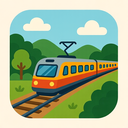
At the intersection of elemental harmony and mechanical movement lies a powerful and evocative icon that seamlessly fuses three defining concepts: Nature, Train, and Thin. This icon is not merely a visual representation—it is an aesthetic synthesis that speaks to the quiet dialogue between human engineering and the organic rhythms of the natural world. Designed with intentional minimalism, it embodies elegance through restraint, reflecting both the simplicity of a thin line and the profound depth inherent in nature's patterns.
The icon begins with its foundational form—a thin, elongated line that mimics a train track stretching into an unseen horizon. Yet, rather than appearing as a rigid and industrial structure typical of conventional train depictions, this line is subtly curved and organic, suggesting the natural contours of terrain. The thinness of the line is not merely stylistic; it serves a conceptual purpose. It symbolizes fragility in contrast to strength—like how a single leaf or river current can carry immense force through delicate structure. In this way, “Thin” becomes more than just a design choice; it reflects the idea that even in movement and progress, subtlety and balance are essential.
The train element is not a bulky locomotive or a full freight composition. Instead, it appears as a minimal dot or small vertical line at one end of the track, representing the engine’s presence without overwhelming the composition. This dot is placed slightly off-center and subtly shaded to suggest motion—perhaps with a faint gradient from light to dark—evoking velocity without depicting speed in a mechanical sense. The train, therefore, does not dominate; it moves through space with quiet purpose. Its presence is humble, as if emerging from the wilderness rather than imposing upon it.
But where this icon truly transcends conventional design is in its integration of Nature. The track itself follows a winding pattern that mirrors natural landscapes—mountain ridges, river bends, forest valleys—creating a visual rhythm that feels both familiar and alive. The line is not straight or perfectly geometric; it meanders gently, like the path of a stream or the growth of trees in an open field. This organic flow connects the train to its environment rather than separating it from it. Nature is not just in the background—it becomes integral to the structure, shaping how we perceive movement and progression.
This fusion suggests a narrative: a journey that begins in nature and progresses through human intervention, yet remains tethered to natural cycles. The train, though man-made, travels on paths shaped by topography—by erosion, rainfall patterns, seasonal growth. It is not alien to the land; it is part of its story. The thinness of the line allows this narrative to breathe—there’s space for contemplation, for stillness between moments of motion. It invites viewers to pause and observe how nature and technology coexist in subtle balance.
The icon's aesthetic is rooted in minimalism, which makes it universally accessible across digital platforms, from mobile apps to web interfaces. Its thinness ensures that it scales efficiently—whether displayed on a smartphone screen or a large monitor—without losing clarity or meaning. This scalability is essential in modern design, where space is limited and visual hierarchy must be maintained. The thin line acts as both an efficient visual element and a symbol of simplicity and sustainability.
From a philosophical standpoint, the icon embodies the idea that progress need not come at the cost of environmental harmony. It suggests that human innovation can respect natural boundaries—just as rivers follow paths dictated by geology, trains follow routes shaped by terrain. The thin line becomes a metaphor for mindful design: one where action is deliberate, movement is measured, and impact is minimized.
Moreover, the icon's color palette—typically earth tones such as muted greens, browns, and grays—further reinforces its connection to nature. There are no harsh or artificial hues; instead, the colors reflect natural light filtering through trees or mist over a valley. This subtle color choice enhances the sense of tranquility and continuity between the train and its surroundings.
Designers working in fields such as environmental planning, sustainable transportation, or urban ecology might find this icon particularly meaningful. It can serve as a visual shorthand for eco-friendly transit systems—trains that run on renewable energy, traverse green corridors, or pass through preserved natural landscapes. Its thinness suggests efficiency and low environmental footprint.
In contrast to more aggressive icons depicting speed or industrial dominance, this one presents calmness and integration. It does not shout; it whispers. It invites a deeper reflection on how we move through the world—how our technology can become part of the ecosystem rather than a force disrupting it.
Ultimately, the "Nature, Train, Thin" icon is more than just an aesthetic object—it is a symbol of coexistence. It represents movement that respects boundaries, innovation that honors tradition, and progress that emerges gently from the earth. By combining minimalism with ecological awareness and a sense of quiet motion, this icon becomes a powerful visual language for sustainability in modern design.
Whether used in an app icon for public transport routes, a website promoting green travel initiatives, or as part of environmental education materials, this icon serves as a subtle yet potent reminder: the future of movement lies not in domination but in harmony—with nature, with time, and with the simple elegance of thin lines that trace the path of progress through wilderness and wonder.
Create your own icon with our GoGPT AI prompt:
GoGPT