

Nature Tree Digital glitch – Free icon download
Download all to grab every PNG variant.
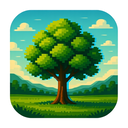
Icon Description: The Fusion of Nature, Tree, and Digital Glitch
This icon represents a powerful visual metaphor that seamlessly blends the organic vitality of Nature with the chaotic elegance of Digital glitch, centered around a central figure — a majestic Tree. It is not merely an aesthetic composition; it is a conceptual bridge between the natural world and the digital realm, evoking both harmony and dissonance in equal measure. The icon stands as a symbolic artifact of our evolving relationship with technology, suggesting that even in a hyper-digital age, elements of raw nature persist — often distorted, transformed, or reinterpreted through technological lenses.
At its core lies the Tree, rendered not as a traditional botanical illustration but as an abstract yet deeply rooted symbol. The trunk is thick and solid, formed from a series of layered geometric shapes that resemble digital blocks or pixels — each one slightly warped, fragmented, and subtly distorted. These pixel-like segments are not perfectly aligned; instead, they exhibit the telltale signs of a Digital glitch: sharp edges that flicker in and out of focus, color shifts from green to electric cyan or deep purples, and subtle static patterns that ripple across the surface. This transformation does not diminish the tree’s presence — rather, it amplifies it. The trunk is both resilient and vulnerable, embodying the paradox of nature existing within a system that is inherently artificial.
Extending from the trunk are branches that appear as organic fractals — branching out with natural irregularity and growth patterns. However, these branches are not entirely free from digital interference. At key junctions, they fracture into glitched lines: jagged, overlapping segments that pulse like corrupted data streams. Some of the leaves are rendered as digital pixels — each one a tiny square of vibrant green or lime, but many have been distorted by color bleed or screen saturation effects common in old CRT displays or low-bandwidth transmissions. A few leaves appear to have vanished entirely, replaced by blank spaces filled with faint static noise — a visual echo of data loss in digital communication.
The background of the icon is not empty; it is a dynamic field of ambient digital interference. It features subtle waveforms that ripple like electromagnetic pulses, mimicking the natural flow of energy through ecosystems — such as sunlight or wind patterns — but reinterpreted through the lens of binary code and network transmission. These waves subtly interact with the tree’s structure, sometimes merging with branches or flickering in response to motion-like movements that suggest a living, breathing entity embedded within a machine.
One of the most striking features of this icon is its duality: nature is not destroyed by digitalization — it is reinterpreted. The Tree does not fade into pixels; instead, the digital glitch acts as both an observer and a transformer. It reveals how nature can be captured, simulated, or even corrupted by technology — a reflection of our modern reality where ecosystems are monitored through sensors, modeled in software simulations, and sometimes misrepresented through visual data pipelines. The icon thus comments on environmental surveillance: while we use digital tools to study forests and climate patterns, those representations often carry inaccuracies or distortions that mirror the Digital glitch aesthetic.
The color palette of the icon is carefully balanced between natural tones and artificial hues. The base green of the tree remains dominant, symbolizing life, growth, and sustainability. However, it is interwoven with digital shades — electric blues for data flow lines, neon reds for error signals or corrupted nodes, and deep blacks where glitch patterns intersect or obscure parts of the trunk. This contrast emphasizes tension between organic authenticity and artificial simulation. The green does not dominate in a purely static way; instead, it pulses subtly when the glitch elements become active — as if the tree is breathing through its digital body.
From a design perspective, this icon would be ideal for applications related to environmental technology, sustainability initiatives, or digital ecology projects. It speaks directly to audiences concerned about climate change while acknowledging that technological solutions are not neutral — they carry their own aesthetic and ethical baggage. The visual language of the glitch is not merely decorative; it serves as a warning: every digital representation of nature carries the potential for misrepresentation, loss of context, or even ecological misinformation.
Moreover, this icon can be interpreted as a meditation on memory and perception. In our digital age, memories are stored in fragmented data streams — just as the tree’s leaves appear scattered or missing. The glitch becomes a metaphor for how we remember nature: not perfectly, but through filtered versions shaped by technology and human bias. The Tree, therefore, stands not only as a symbol of life but also as a repository of memory — one that is both intact and corrupted in equal measure.
In conclusion, the icon of Nature, Tree, and Digital Glitch is more than a visual design; it is an interdisciplinary statement on identity, transformation, and coexistence. It merges the stability of natural growth with the instability of digital systems to create a dynamic image that challenges viewers to consider how we perceive and preserve nature in an increasingly technological world. The Tree remains central — rooted in reality yet entangled in data — a reminder that even in our most advanced digital environments, the essence of nature persists, if only we are willing to see it through the lens of both wonder and imperfection.
As such, this icon is not just beautiful — it is thought-provoking. It invites exploration into the boundaries between organic and synthetic, real and simulated. Whether used in branding for environmental tech startups, educational materials on digital ecology, or art installations about climate consciousness, the fusion of Nature, Tree, and Digital Glitch offers a powerful visual narrative that resonates with both scientific rigor and poetic sensibility.
Create your own icon with our GoGPT AI prompt:
GoGPT