

Nature Tree Geometric – Free icon download
Download all to grab every PNG variant.
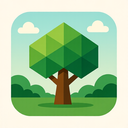
The icon in question is a sophisticated visual representation that masterfully integrates the essence of Nature, the symbolic power of a Tree, and the precision and balance inherent in Geometric design. This composite icon transcends simple illustration; it is an artistic dialogue between organic vitality and mathematical harmony, offering both aesthetic appeal and deep conceptual meaning. The icon is not merely a static image but a dynamic symbol that embodies the interconnectedness of the natural world with structured systems — a reflection of how nature operates through patterns, growth, and cycles that mirror geometric principles.
At its core, the icon features a stylized Tree. However, this tree is not rendered in a literal or traditional sense. Instead, it is abstracted to emphasize form over realism. The trunk is not a straight vertical line; rather, it emerges as an elegant helical structure — a spiral that grows progressively from the base upward, echoing the natural growth patterns of trees such as birch or pine. This helix represents both the spiraling motion of life and development and serves as a foundational element upon which more intricate forms are built. The branches radiate outward in symmetrical yet organic arcs, forming an intricate web that mimics both the branching pattern found in real trees and the radial symmetry of geometric shapes like circles or polygons.
What makes this representation truly unique is the seamless integration of Geometric elements throughout. The branches do not simply spread freely; they intersect with intersecting lines, triangles, and polygons that appear to form a lattice or grid system. These geometric patterns are not imposed haphazardly — instead, they emerge naturally from the tree’s structure, creating zones of overlapping shapes that evoke balance and order. For example, every major branch terminates in a triangle formed by three equally spaced lines extending outward at 120-degree angles. These triangles suggest stability and growth potential — a nod to how geometric forms are often used in architecture or design to symbolize strength and resilience.
The roots of the tree are also treated with geometric precision. Rather than being depicted as tangled, earth-bound mass, they appear as interlocking hexagons or tessellating squares that extend downward into a flat plane. This representation reflects how natural root systems often develop in patterns driven by environmental pressure and efficiency — a concept mirrored in geometric tessellation, where shapes fit together seamlessly without gaps or overlaps. The use of hexagonal shapes, in particular, draws from biological and geological principles — such as the structure of honeycombs or crystal lattices — reinforcing the link between natural processes and mathematical logic.
The canopy of the tree is another point where nature and geometry converge. Instead of a dense mass of foliage, it is composed of concentric rings or layers, each ring slightly offset from the one above it. These rings are formed using circular arcs that gradually increase in radius, creating a visual rhythm reminiscent of both tree growth and the Fibonacci spiral — a mathematical sequence found naturally in shells, seeds, and leaves. This spiral pattern is not only visually compelling but also symbolically significant: it illustrates how natural systems evolve through self-similar patterns governed by underlying mathematical laws.
Coloration plays an essential role in reinforcing the icon’s thematic depth. The trunk is rendered in deep earth tones — moss green, warm brown, and terracotta — evoking the organic feel of a forest floor and mature wood. The branches transition into lighter shades of sage and sky blue as they ascend, symbolizing growth and openness to the sky. Geometric elements such as triangles or grids are outlined with soft strokes in silver or graphite gray, providing a contrast that enhances clarity without disrupting the natural ambiance. This balance ensures that while the geometric components bring structure and precision, they do not override the organic vitality of nature.
Functionally, this icon can serve multiple purposes across design applications — from environmental awareness campaigns to educational materials about ecosystem dynamics or sustainable architecture. Its visual language appeals to both scientific and artistic sensibilities. It is equally accessible to children learning about nature and adults exploring complex systems in ecology or design theory. The icon encourages viewers to see nature not as chaotic randomness but as a system governed by elegant, repeating patterns — a truth affirmed across biology, mathematics, and philosophy.
Furthermore, the fusion of Nature with Tree and Geometric design makes this icon highly adaptable. It can be scaled to fit small digital interfaces or expanded into large-scale murals in public spaces. Whether used as a logo for an eco-friendly product line, a sustainable urban planning initiative, or a wellness brand promoting balance and grounding, the icon maintains its integrity and symbolic strength.
In conclusion, this icon is more than just a visual object — it is a modern metaphor that celebrates the harmony between organic life and mathematical structure. It acknowledges that nature does not operate in isolation from patterns; rather, it is deeply embedded within them. By combining the fluidity of a tree with the precision of geometric forms, this design offers a powerful reminder that beauty, growth, and stability are not mutually exclusive — they coexist in every leaf’s shape and every root’s path. The integration of all three core elements — Nature, Tree, and Geometric — transforms the icon into a lasting symbol of balance, resilience, and interconnectedness in our world.
Create your own icon with our GoGPT AI prompt:
GoGPT