

Politics Flower 3D isometric Free icon download
Download all to grab every PNG variant.
```html
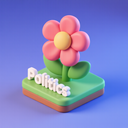
This meticulously crafted icon represents a profound synthesis of seemingly disparate elements—politics, nature’s beauty embodied in the flower, and modern digital artistry expressed through 3D isometric design. At first glance, it appears as an elegant graphical symbol suitable for digital interfaces, political campaigns, environmental advocacy platforms, or social awareness movements. But upon deeper inspection and thoughtful analysis of its components and symbolic meaning, this icon reveals itself as a richly layered representation of modern democratic ideals: the intersection of power with peace, authority with empathy.
The central figure is a stylized rose—its petals rendered in soft gradients from deep crimson to warm blush pink—suspended at the heart of a balanced geometric framework. The rose does not merely sit on a flat surface; instead, it exists within an intricate 3D isometric space, where depth and perspective are artistically emphasized. Every petal is precisely angled to suggest volume and dimensionality, with subtle shading that creates realistic light reflections as if illuminated from a top-left source. This technique transforms the flower into more than decoration—it becomes a three-dimensional metaphor: the fragility of ideals, the strength found in unity, and the enduring presence of beauty even amidst complex political realities.
Surrounding the rose is an abstract representation of governance—a stylized, minimalist parliament building rendered in clean lines and geometric symmetry. Constructed from sharp-edged polygons with a metallic sheen, this structure floats gently around the flower, suggesting that institutions of power should nurture and protect natural beauty rather than suppress it. The architecture adheres strictly to 3D isometric projection: horizontal and vertical lines remain parallel to the axes of the plane, while diagonal lines converge at consistent angles (typically 30 degrees), creating an illusion of depth without distorting perspective. This visual language gives the entire icon a modern, digital aesthetic, reminiscent of interface design in apps or data visualization tools where clarity and spatial awareness are crucial.
What makes this icon truly unique is how it fuses politics and nature into a single cohesive symbol. The flower—often associated with peace, growth, love—serves as the focal point of democratic values. It is not a passive element; rather, its stem extends upward through the base of the parliament building like a root system reaching for sunlight. This subtle design choice implies that true political power must be grounded in ethical foundations and ecological responsibility. The rose’s presence at this intersection signals that leadership should inspire growth, compassion, and beauty—not coercion or division.
Additionally, the 3D isometric style enhances the icon’s conceptual depth. Unlike flat illustrations, which may feel static or one-dimensional, the isometric view allows viewers to mentally "walk around" the image. This dynamic spatial awareness mirrors how modern political discourse operates: complex, multi-faceted, and requiring a holistic understanding. Each angle of the icon reveals new relationships—between institution and nature, between structure and organic form, between authority and care. The use of perspective also evokes themes of transparency: in a world where politics is often shrouded in opacity, this icon stands as a call for visibility, clarity, and openness.
Color choices further amplify the message. The rose’s warm hues contrast gently with the cool grays and steel blues of the parliamentary structure—symbolizing emotional intelligence meeting rational governance. Subtle green accents on the stem and base suggest sustainability, environmental stewardship, and long-term thinking—values increasingly central to contemporary political agendas. Even in its digital form, the icon feels tactile; one can almost sense its weight in space, inviting interaction rather than mere observation.
Designed with both aesthetic elegance and symbolic potency in mind, this 3D isometric icon serves as more than a visual element—it’s a narrative device. It speaks to generations raised on digital interfaces who crave meaning behind design. Whether used on websites advocating for green politics, campaign materials promoting inclusive leadership, or educational content about civic engagement, the icon communicates that real political change begins with beauty, balance, and biodiversity in our values.
In essence, this icon is a visual manifesto: power does not need to be oppressive; peace does not require passivity. When politics embraces nature through the lens of modern design—when leadership nurtures growth like a flower fed by sunlight—then democracy becomes not just functional, but truly beautiful.
```Create your own icon with our GoGPT AI prompt:
GoGPT