

Politics Globe Retro Free icon download
Download all to grab every PNG variant.
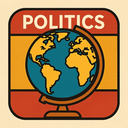
At first glance, the "Retro Politics Globe" icon appears as a simple yet striking visual representation that seamlessly blends three distinct yet harmonious themes: Politics, Globe, and Retro. What initially draws the eye is its nostalgic aesthetic—crafted with deliberate vintage design choices that evoke a bygone era of political cartography and mid-20th-century graphic design. The icon captures not just the physical image of Earth but also encapsulates centuries of global political dynamics through a lens imbued with retro charm, making it more than just an emblem—it’s a storytelling artifact.
The central element is undeniably the globe: meticulously rendered in stylized fashion with exaggerated curvature and visible landmass contours that resemble those found on early 20th-century world maps. Unlike modern digital globes that emphasize precision and realism, this retro-inspired version features subtle distortions—particularly around the polar regions—emphasizing artistic interpretation over cartographic accuracy. These deliberate imperfections are key to its retro identity, harking back to a time when mapmakers were as much artists as scientists, and political boundaries were often fluid and subject to change based on shifting alliances and imperial ambitions.
The globe itself is encircled by a stylized equatorial band that resembles the metallic rim of an old-school phonograph record or the frame of an analog television screen—a clear nod to retro technology. This circular border not only reinforces the icon’s vintage character but also symbolizes continuity, cycles, and global interconnectedness. Within this ring, faint concentric grooves are etched in a weathered silver tone, reminiscent of vinyl records that once carried political speeches, revolutionary manifestos, or international broadcasts during pivotal moments in history—from the Cold War to post-colonial independence movements.
As for coloration, the icon employs a muted yet evocative palette characteristic of retro design. The continents are rendered in deep earthy tones—burnt orange for Africa, forest green for South America, ochre for Asia—with sharp, hand-drawn outlines that mimic early 1960s map aesthetics. The oceans are a faded teal-blue with subtle gradient effects simulating water ripples or old film grain—a texture often found on vintage postcards and political posters from the 1950s and '70s. This deliberate use of color saturation reduction, slight blur, and intentional imperfections ensures that the icon does not feel modern or sterile but rather authentic to a time when politics was both visible through print media and deeply intertwined with global imagery.
The political symbolism embedded within the design is both subtle and profound. Embedded across select continents are tiny but distinct insignia: a small hammer and sickle over Eastern Europe (a reference to Soviet influence), a stylized eagle near North America (symbolizing American foreign policy), an abstract flag icon in West Africa, and delicate dotted lines representing former colonial borders. These elements do not dominate the composition but rather appear as historical traces—faint echoes of ideological struggles, decolonization waves, and global power shifts that shaped modern geopolitics. The inclusion of these symbols isn’t meant to endorse any specific ideology but to acknowledge the complex legacy of political influence across continents.
Perhaps most intriguing is how the icon incorporates retro design techniques such as halftone patterns, limited color palettes, and manual line art—elements commonly used in pre-digital print media. The globe appears slightly grainy or pixelated when viewed up close, mimicking the texture of a 1970s newspaper illustration or a faded political pamphlet from the height of the non-aligned movement. This tactile quality gives the icon an almost physical presence, as if it were plucked from an old archive or displayed on a vintage bulletin board in a diplomatic office during the Cold War era.
Functionally, this icon serves multiple purposes in modern contexts. It can represent global politics platforms, international diplomacy events, historical educational content about geopolitical evolution, or even be used as branding for retro-inspired political commentary websites and documentaries. Its nostalgic appeal makes it instantly recognizable yet timeless—offering both a sense of familiarity and intrigue to viewers who are drawn to the aesthetics of past decades while being relevant in today’s fast-paced digital landscape.
Ultimately, the Retro Politics Globe icon transcends mere visual representation. It is a multidimensional symbol—a fusion of geography, historical memory, and aesthetic reverence for design eras past. It reminds us that politics has always been a global endeavor shaped by shifting boundaries, cultural exchange, and ideological currents. By wrapping this profound concept in retro sensibilities—those warm imperfections of hand-crafted design—the icon becomes not just a picture but a narrative: one that speaks to the enduring nature of global influence, the evolution of political thought, and the power of vintage aesthetics to communicate complex ideas with elegance and depth.
Create your own icon with our GoGPT AI prompt:
GoGPT