

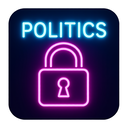
Politics Lock Neon Free icon download
Download all to grab every PNG variant.
```html
At first glance, the Neon Politics Lock icon appears as a striking fusion of modern digital aesthetics and profound political symbolism. Its visual language is both arresting and layered—combining the sharp geometry of a security mechanism with the pulsating energy of neon art. This icon does not merely represent politics; it embodies a contemporary cultural tension between transparency and control, freedom and surveillance, democratic ideals and authoritarian grip. At its core, the icon features a stylized lock—yet unlike any conventional padlock—it is rendered in vibrant electric hues that seem to emit their own light from within.
The lock itself is designed with architectural precision: its cylindrical body tapers slightly toward the base, suggesting both strength and mechanism. The keyhole, positioned centrally at the top of the lock's face, glows with a deep violet aura, as if infused with hidden knowledge or encoded power. Surrounding the keyhole is a complex pattern resembling encrypted circuitry—thin lines in electric cyan and magenta that intersect like neural pathways or digital schematics. These filaments pulse rhythmically in animation (if interactive), mimicking the heartbeat of an algorithmic system managing political information.
What elevates this icon beyond mere representation is its use of neon lighting. The lock's frame radiates a halo of bright magenta and electric blue, with shimmering edges that suggest light bleeding through dark urban environments. This neon glow does not merely illuminate—it symbolizes visibility, urgency, and rebellion. In the context of politics, where truth often remains obscured behind layers of bureaucracy or propaganda, the icon uses neon as a metaphor for revelation: it demands attention. It is not passive; it shouts from the digital landscape with an intensity akin to protest signs in city streets or flashing headlines during political crises.
Embedded within the neon glow are subtle motifs that reinforce its political dimension. Tiny silhouettes of figures—some raising hands in protest, others gathered around a table negotiating, a lone figure standing atop a podium—are faintly etched into the outer edges of the lock’s radiant aura. These ghostly outlines suggest collective action and human agency within systems of power. Yet their transparency warns that influence is often fragile, easily suppressed or manipulated by those who control access.
From a design standpoint, the icon leverages contrast to amplify its message: dark backgrounds represent secrecy and opacity, while the vibrant neon elements symbolize truth breaking through. This duality mirrors real-world political dynamics—where democratic institutions promise openness but often operate behind closed doors. The lock, traditionally a tool of protection, becomes an allegory for both security and oppression depending on who wields it. In this iconography, the lock is not inherently good or evil—it is a neutral mechanism that reflects the intentions of those in power.
The choice of neon over traditional metallic finishes is deliberate and rich with cultural meaning. Neon has long been associated with urban nightlife, digital culture, and countercultural movements. It appears in graffiti art, political murals, and protest rallies—particularly during moments when marginalized voices demand visibility. By adopting this aesthetic for a symbol traditionally linked to secrecy (the lock), the icon subverts expectations: it transforms what was once a tool of exclusion into an emblem of resistance.
When viewed in context with digital platforms—social media, political campaign visuals, or anti-surveillance messaging—the Neon Politics Lock becomes more than just a symbol. It functions as a call to action: to question who controls information, who holds the keys to democracy, and how transparency can be maintained in an age of data manipulation. The pulsing glow suggests that truth is not static—it requires constant vigilance, much like the act of monitoring a secure system.
In essence, this icon fuses three powerful concepts—Politics (the domain of power, governance, and public discourse), Lock (symbolizing control, secrecy, access), and Neon (representing visibility, urgency, and modernity)—into a single compelling visual narrative. It captures the paradox of our time: a world where political power is more accessible than ever through technology yet simultaneously more opaque due to surveillance networks and algorithmic gatekeeping.
In conclusion: The Neon Politics Lock icon is not just a graphical element—it is a cultural artifact. It speaks to the digital age’s central contradiction: that our most powerful tools for connection and expression can also be used to isolate, surveil, and control. By merging political symbolism with the visceral energy of neon lighting and the universal meaning of a lock, this icon becomes an enduring reminder that democracy must remain vigilant, transparent—and brilliantly visible in the dark.
```Create your own icon with our GoGPT AI prompt:
GoGPT