

Politics Medical cross Steampunk Free icon download
Download all to grab every PNG variant.
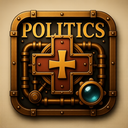
Imagine a meticulously crafted icon that fuses the symbolic weight of political authority with the universal emblem of healing—the medical cross—encased within a richly detailed steampunk aesthetic. This is not merely an image; it is a narrative artifact, a visual paradox that embodies the tension between governance and care, power and compassion, innovation and tradition—all rendered through the lens of 19th-century industrial fantasy.
The icon’s central element is the medical cross, rendered in polished brass with subtle rivet detailing along its edges. Each arm of the cross is slightly curved, echoing both ancient symbolism and futuristic engineering. The cross itself pulses with a faint, internal glow—like a low-frequency steam valve releasing energy—not from electricity but from an intricate network of glowing blue liquid (resembling mercury or coolant) flowing through transparent glass tubing embedded within its structure. This subtle luminescence symbolizes the lifeblood of medicine: care, continuity, and scientific progress.
Surrounding the medical cross is a complex ring of interlocking gears, made from weathered bronze and copper. These cogs are not uniform; some are larger, others smaller—each bearing engraved inscriptions in a pseudo-Victorian script that reads fragments of political manifestos: “Health for All,” “Justice Through Regulation,” and “The People’s Wellbeing.” The gears rotate slowly, almost imperceptibly, suggesting the constant motion required to maintain balance between public policy and healthcare delivery. They are not just decorative; they represent the machinery of governance—the bureaucratic engine that must keep pace with medical advancements.
At the top of the icon, a stylized brass crown—reminiscent of an imperial or parliamentary symbol—is fused seamlessly into a large, exposed steam chamber. From this chamber emerges a thin spiral of white vapor, which curls upward like smoke from an old-world telegraph line. The steam carries faint silhouettes—figures in top hats and long coats engaged in debate, negotiation, or legislation—which dissolve into the air before they can be fully seen. These ghostly figures suggest that politics is not static; it is a dynamic process of constant motion, dialogue, and evolution.
On the left arm of the cross stands a miniature figure resembling a Victorian doctor—wearing goggles with brass frames, an apron lined with tiny pockets for instruments, and gloves made from stitched leather. He holds a stethoscope that connects to a complex tube system leading into the heart of the icon. His face is partially obscured by shadow, symbolizing the ambiguity between idealism and reality in medical practice—especially when influenced by political mandates.
On the right arm, another figure appears: this one dressed as a statesman or bureaucrat, adorned with a sash bearing insignias from various ministries. He clutches a scroll inscribed with regulations and funding codes. His eyes are closed, as if in deep contemplation—perhaps weighing the cost of healthcare innovation against political feasibility. This duality is central to the icon’s meaning: politics shapes medicine, but medicine demands political will.
The base of the icon is a thick slab of dark oak, treated with soot and grime to evoke industrial decay, yet it is anchored by a pair of sturdy brass stilts that resemble locomotive wheels. These wheels are not meant to roll; instead, they are fused into the ground—symbolizing how political and medical systems can become entrenched over time. They also subtly suggest infrastructure: roads for ambulances, railways for medicine delivery, and power lines for hospitals.
The entire icon rests upon a circular platform engraved with an intricate map of a fictional nation—the “Republic of Vitalis”—a place where healthcare is constitutionally guaranteed, but the system is perpetually on the verge of collapse due to bureaucratic red tape. The map glows faintly when viewed under certain lighting, revealing hidden pathways labeled “Emergency Funding,” “Public Health Initiative,” and “Ethical Oversight.” These are not just decorative elements; they represent the unseen mechanisms that sustain or undermine public trust in both politics and medicine.
Surrounding the base are four smaller steam-powered devices: a typewriter (for policy drafting), a model of an early x-ray machine (medical innovation), a voting machine with brass levers (democratic participation), and a small clock tower displaying not hours, but “Public Trust Levels.” The clock’s hands move erratically, reflecting the volatility of political and medical confidence in real-world governments.
Finally, at the very center—where all lines converge—is a tiny glass orb containing a swirling vortex of blue light. This is the "Heart of Balance," symbolizing the ideal: a society where politics supports medicine without overregulating it, and where medical science advances without being ignored by lawmakers. The orb flickers when approached, as if responding to emotional or ethical input—a subtle reminder that governance and healing are not just systems, but moral responsibilities.
This icon is more than a visual symbol. It is a commentary on the complex relationship between power and care in modern society—between who makes decisions about health, how those decisions are implemented, and what happens when politics interferes with healing or medicine becomes politicized. The steampunk aesthetic elevates this message into something mythic: an artifact from an alternate past where industrial progress was matched by ethical ambition.
In a world increasingly defined by healthcare crises, political polarization, and technological upheaval, this icon stands as both warning and hope—a reminder that the future of medicine depends not just on science, but on wisdom in governance. And perhaps most importantly: that true progress lies not in choosing between politics and medicine—but in forging a system where they coexist with mutual respect.
Create your own icon with our GoGPT AI prompt:
GoGPT