

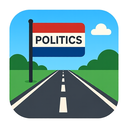
Politics Road Flat design Free icon download
Download all to grab every PNG variant.
The icon under description is a meticulously crafted representation that masterfully blends three distinct yet harmoniously integrated concepts—Politics, Road, and Flat Design. At first glance, the visual simplicity of its form may suggest minimalism at its peak; however, beneath this surface lies a rich tapestry of symbolic meaning and intentional design choices that speak volumes about contemporary digital communication. The icon features a streamlined composition rooted firmly in flat design principles—a modern aesthetic characterized by two-dimensional visuals with no gradients, shadows, or intricate textures. This approach eliminates visual clutter and enhances clarity, making the icon instantly recognizable even at small sizes. The color palette is intentionally restrained: deep navy blue serves as the dominant hue, symbolizing stability and authority—qualities often associated with political institutions—while a vibrant lime green accents certain elements to represent progress, movement, and forward momentum. This contrast not only adds visual interest but also reinforces the icon’s thematic duality between governance and motion. Central to the composition is a stylized road that arcs diagonally across the icon's frame. The road is depicted as a smooth, continuous line with clean edges—another hallmark of flat design—divided into two lanes, each clearly defined by crisp white lines. Unlike traditional illustrations of roads that might include depth cues like vanishing points or perspective distortions, this representation remains entirely flat and geometrically precise. The road’s trajectory forms a subtle curve resembling an upward slope, suggesting ascent, advancement, or the pursuit of policy goals—an elegant metaphor for political progress. At the intersection where the road meets a central focal point sits a stylized flagpole with a triangular flag waving gently. The flag is not representative of any specific nation but rather embodies generic political symbolism: it is divided into three equal sections—blue, white, and green—each color carrying symbolic weight. Blue signifies trust and governance; white represents neutrality and transparency; green stands for growth, sustainability, and forward-thinking policies. The flag’s shape—a downward-pointing triangle—is reminiscent of the "suggestion" or "idea" symbol often used in conceptual illustrations, subtly suggesting that political discourse is rooted in ideas rather than power alone. The road itself does not terminate at a boundary but continues beyond the icon's edges, creating an implied sense of continuity. This design choice reinforces the idea that politics and progress are ongoing processes—never static or fully resolved. The absence of endpoints challenges viewers to consider the journey rather than just the destination, a powerful statement in today’s fast-paced political discourse where outcomes often dominate conversation. Integrating flat design with thematic depth, every element in this icon is deliberately simplified yet purposeful. For instance, the road’s lane dividers are not merely decorative; their spacing and symmetry reflect balance and order—core tenets of effective governance. The clean lines and sharp corners emphasize precision and reliability, qualities that resonate with public expectations for political leaders to be clear, consistent, and accountable. Moreover, the icon subtly incorporates negative space to guide the viewer’s eye through its narrative. The space between the road segments forms a gentle upward arrow when viewed in context—an abstract symbol often used in design to represent progress or improvement. This hidden element demonstrates how flat design can carry layered meanings without sacrificing simplicity. The political dimension of this icon is further enriched by its minimalism. In an era saturated with visual noise, especially in digital media where political content often dominates headlines, such a clean and restrained image stands out as a beacon of clarity. It communicates that politics need not be complex to be impactful—sometimes, the most powerful messages are delivered through simplicity. Additionally, the road serves as both literal and metaphorical imagery. Literally, it represents infrastructure—the physical foundation upon which societies thrive. Politically, roads symbolize connectivity: between communities, ideas, policies. They link governance with citizens and facilitate exchange on every level. This duality makes the icon particularly potent in contexts such as government websites, civic engagement platforms, or policy discussion forums. In conclusion, this icon is more than a visual symbol; it is a narrative in form. Through its fusion of politics (symbolized by the flag and governance-related color scheme), road (as both literal pathway and metaphorical journey), and flat design (offering clarity, modernity, and accessibility), it encapsulates a profound message about progress through thoughtful leadership. It invites viewers to reflect on the path ahead—not just in infrastructure, but in democratic engagement. In an age where digital icons shape how we perceive complex ideas, this image stands as a testament to the power of intentional design: simple in form, deep in meaning.
Create your own icon with our GoGPT AI prompt:
GoGPT