

Politics Robot Flat design Free icon download
Download all to grab every PNG variant.
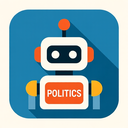
The icon described is a visually striking and conceptually rich representation that masterfully combines the themes of politics, robotics, and flat design into a cohesive digital symbol. At first glance, this icon appears minimalist—clean lines, solid colors without gradients or shadows—but upon closer inspection reveals layers of meaning tied to the intersection of technology and governance. Designed within a strict flat design aesthetic, every element is intentionally simplified yet profoundly symbolic. The central figure in this icon is a stylized robot—a humanoid form rendered with geometric precision. Its body is composed of clean rectangular shapes: a square torso, cylindrical limbs, and a hexagonal head that gives it both an industrial and futuristic appearance. The robot’s face features two large, circular eyes positioned symmetrically above an abstract mouth represented by three horizontal bars—an expressionless visage that conveys neutrality and objectivity. This deliberate lack of emotional features underscores the icon's core theme: a machine operating within the political sphere not driven by bias, but by logic, data, and programmed principles. The flat design approach is evident in every aspect of the icon. There are no gradients or textures; instead, solid blocks of color create strong visual contrast. The robot is rendered primarily in shades of steel gray and metallic silver for its body, symbolizing technological neutrality and precision. Its eyes are bright blue—symbolic not only of clarity and innovation but also subtly evoking a sense of trustworthiness often associated with digital systems. The background is a pure white or light gray plane, emphasizing the icon’s two-dimensional nature and reinforcing the flat design philosophy that prioritizes clarity over realism. What transforms this simple robot into a political symbol lies in its symbolic gestures and contextual cues. One arm is raised upward in a gesture reminiscent of voting or advocacy—an open palm pointing skyward, suggesting participation and representation. This hand movement becomes an allegory for digital democracy: a robot as a citizen who has transcended biological limitations to engage in the democratic process. The other arm rests at its side, slightly bent at the elbow, conveying readiness and vigilance—qualities associated with political oversight and accountability. The robot’s head is tilted slightly upward, not in reverence but in contemplation—a posture that suggests analytical thinking rather than emotional response. This subtle angle implies that political decision-making through AI or robotics is not about blind obedience to authority but about reasoned evaluation of policy, data, and ethical frameworks. In this way, the icon speaks to modern debates on artificial intelligence governance: how machines can assist in democratic processes without undermining human agency. Embedded within the robot’s chest area is a small circular emblem—a stylized shield composed of three overlapping geometric shapes: a triangle (representing stability), a circle (symbolizing unity and wholeness), and a square (denoting structure and order). This emblem, rendered in deep blue with white inner lines, evokes national or institutional identity while maintaining the flat design language. It serves as a subtle nod to political institutions—governments, parliaments, or regulatory bodies—suggesting that this robot is not an outsider but a member of the political ecosystem. The icon’s proportions and symmetry further reinforce its message of balance and impartiality. The robot stands upright on two flat, square feet positioned directly beneath its center of gravity—a visual metaphor for stability in governance. The absence of any exaggerated features ensures that the viewer’s attention remains focused on the conceptual fusion: technology serving public interest through transparent, rational mechanisms. From a practical standpoint, this icon would be ideal for use in digital platforms related to political technology (politechnology), AI policy-making tools, civic engagement apps, or educational resources about future governance. Its flat design makes it highly scalable—equally effective as a 16px favicon or a 512px banner. The limited color palette (steel gray, blue, white) ensures accessibility and compatibility across dark mode and light mode interfaces. Crucially, the icon avoids reinforcing dystopian stereotypes of robots in politics—such as robotic overlords or authoritarian AI. Instead, it portrays the robot as a collaborative agent: a digital citizen contributing to democratic discourse with objectivity and transparency. This optimistic interpretation aligns with contemporary discussions on algorithmic fairness, ethical AI governance, and participatory democracy in the digital age. In essence, this icon is more than a visual symbol—it is a conceptual manifesto. It encapsulates the evolving relationship between technology and politics through a lens of simplicity and intentionality. By merging the cold precision of robotics with the complex human constructs of governance within the minimalist principles of flat design, it challenges viewers to reconsider what democracy might look like in an age where machines play an active role in shaping policy, public opinion, and civic participation. The enduring power of this icon lies not just in its aesthetic elegance but in its narrative depth—an invitation to reflect on how artificial intelligence can serve the people rather than replace them. In doing so, it stands as a bold representation of a future where politics is not only transparent and data-driven but also inclusive, rational, and human-centered—guided by machines that reflect our best ideals.
Create your own icon with our GoGPT AI prompt:
GoGPT