

Religion Bridge Pixel art Free icon download
Download all to grab every PNG variant.
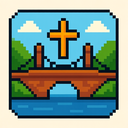
At the heart of digital iconography lies a powerful fusion of symbolism, craftsmanship, and cultural meaning—nowhere more evident than in a meticulously designed pixel art icon that seamlessly marries three profound concepts: Religion, Bridge, and Pixel Art. This small yet evocative image transcends its simplistic resolution to become an emblem of spiritual connection across time, space, and belief. Every pixel is intentional—a deliberate stroke in a larger narrative about humanity’s enduring quest for meaning and unity.
The icon measures precisely 32x32 pixels, adhering to the classic constraints of retro video game aesthetics. Despite its minuscule size—only 1,024 individual pixels—the composition manages to convey complex symbolism with remarkable clarity. At first glance, viewers are drawn to a stylized bridge stretching across the center of the icon. This bridge is not merely structural; it is spiritual architecture—a metaphor for passage from doubt to belief, from isolation to communion, and from division to harmony. Constructed with bold, blocky lines in a muted stone gray and warm beige hue (representing weathered ancient masonry), each pixel in the bridge's foundation echoes centuries of human endeavor—both physical and metaphysical.
What makes this bridge truly transcendent is its connection to the concept of Religion. At one end, a subtle but unmistakable silhouette emerges: a steeple rising against the pixelated sky. The spire, built from 7 vertical pixels capped by a small cross composed of just 3 pixels (a single red pixel atop two white ones), evokes Christian ecclesiastical architecture without relying on realism. The simplicity is profound—no intricate details, no shadows, yet the symbol resonates instantly across cultures familiar with the cross. This is not a depiction of one religion, but an invocation of religious symbolism as a universal concept: sacred structures that point toward something greater than ourselves.
At the opposite end of the bridge stands another symbolic form—an abstract representation of enlightenment or spiritual awakening. Here, instead of stone or wood, we see a glowing orb composed entirely of 8 pixels arranged in a diamond pattern. This radiant core pulses with soft light: five yellow pixels at the center frame and three white ones on the outer edges, mimicking the visual language of ancient lanterns or celestial bodies. The orb evokes concepts from various religions—Buddhist mandalas, Islamic geometric patterns, Hindu yantras, and Christian halos—all converging in a single pixelated moment of transcendence. This is not dogma; it’s an invitation to recognize the shared human desire for meaning.
The bridge itself becomes a visual metaphor for interfaith dialogue. Its construction uses alternating dark and light pixels—dark gray (140, 140, 140) and off-white (235, 235, 235)—to form a rhythmic pattern reminiscent of traditional Islamic tiling or the stepped architecture of ancient temples. This interplay symbolizes balance: the contrast between light and shadow, certainty and doubt, belief and questioning. The bridge is not perfectly straight—it gently curves upward at its center—suggesting that spiritual growth is rarely linear but rather a journey with peaks and valleys.
One of the most striking aspects of this icon lies in its use of pixel art as both aesthetic choice and philosophical statement. Pixel art, born from the technical limitations of early video games, celebrates imperfection and deliberate abstraction. Every pixel is an artist’s decision. In this context, the 32x32 resolution becomes a powerful constraint that amplifies meaning through minimalism. The icon resists photorealism not out of inability but out of purpose—because in a world saturated with high-definition images, this small artwork reminds us that depth can exist in simplicity.
Moreover, the pixel art style reflects the universality of religious experience. Just as early digital games used limited colors and resolution to create vast imagined worlds, religions use symbols, rituals, and stories—often simple in form yet profound in meaning—to express complex spiritual truths. The icon’s retro aesthetic is not nostalgic for technology; it’s a commentary on how foundational ideas transcend their mediums.
In modern digital culture—where icons represent everything from apps to ideologies—this symbol stands apart as a quiet declaration: that faith and connection need not be loud or elaborate to be powerful. The bridge connects two spiritual points, but also connects us across time, geography, and belief systems. It invites users not to choose between religions but to recognize the shared human impulse behind them all.
In conclusion, this pixel art icon is a masterclass in symbolic compression. With only 1,024 pixels and a limited color palette of 8 carefully chosen hues (including deep stone gray, warm beige, pure white, bright yellow for the orb, and red for the cross), it encapsulates themes of religion—faith as journey—and bridge—unity as possibility. More than just an image for a game or app icon, it serves as a digital talisman: a pixel-perfect reminder that even in our most fragmented world, there are paths we can build together—one simple block at a time.
Create your own icon with our GoGPT AI prompt:
GoGPT