

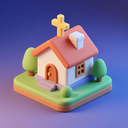
Religion House 3D isometric Free icon download
Download all to grab every PNG variant.
```html
The icon presents a meticulously crafted 3D isometric representation of a religious house—a sacred architectural space that transcends mere shelter to become a profound symbol of spiritual life, communal belonging, and divine connection. The design seamlessly integrates the core elements of Religion, House, and the advanced visual language of 3D isometric rendering to create an icon that is both visually striking and deeply meaningful.
In this 3D isometric view, the religious house stands out as a geometrically precise structure built with layered perspectives that enhance depth and realism. The architectural style draws inspiration from various global traditions—its silhouette subtly echoing elements of Gothic cathedrals, Byzantine domes, Islamic minarets, and traditional temple spires—all harmoniously blended into a single iconographic form. From this isometric angle (typically 30 degrees upward with parallel projection), every component of the structure appears to exist in spatial relationship with the others: walls rise vertically but taper slightly toward the top; roof planes slope at distinct angles; and symbolic features like stained-glass windows, domes, and spires are rendered with precise foreshortening, giving a true-to-life sense of volume.
The central element is a majestic dome at the heart of the structure—a universal emblem of spirituality found across religions. This dome is not just decorative; it serves as an architectural centerpiece that draws the eye upward, metaphorically echoing humanity’s longing to connect with something greater than itself. The dome is segmented with intricate patterns reminiscent of Islamic geometric art, yet softly blended with cross-shaped motifs typical in Christian churches and lotus-like carvings found in Hindu and Buddhist temples. This synthesis underscores the icon's unifying message: that the essence of Religion, regardless of tradition, centers on transcendence, peace, and divine presence.
At the base of the structure lies a sturdy foundation—symbolic not only as an architectural support but as a representation of faith’s grounding in community and moral values. The base is rendered with textured stone blocks in warm beige and gray tones, emphasizing solidity and timelessness. From this foundation emerge wide arched doorways, each framed with carvings that hint at sacred texts, prayer wheels, or symbolic animals like doves (peace), lotuses (purity), or lions (courage). These details are not merely ornamental; they act as visual metaphors for the values and beliefs upheld within the religious house.
One side of the building features a series of tall, narrow windows—some rectangular, others pointed—arranged in a pattern that mimics stained-glass designs. Though rendered in monochrome or subtle gradients to maintain icon clarity, these windows glow faintly from within as if lit by an ethereal light. This effect symbolizes the inner radiance of spiritual enlightenment and communal worship. The 3D isometric perspective ensures that each window appears slightly offset from its neighbor, enhancing the illusion of depth and adding visual rhythm to the façade.
On another side, a small courtyard emerges—a sacred space open to nature—where trees (rendered in simplified yet recognizable forms) grow beneath a canopy of branches. This space symbolizes spiritual renewal and contemplation. At its center lies an ornamental fountain or altar, rendered with isometric precision so that every ripple in the water appears three-dimensional and reflective. The courtyard reinforces the idea that a House, in this context, is not merely physical but also emotional, psychological, and sacred—a place where one can retreat from the world to reconnect with inner truth.
Throughout the icon, attention to lighting and shading enhances its 3D quality. Soft ambient shadows fall across walls and rooftops based on a simulated light source in the upper left corner—consistent with isometric rendering principles. This creates a sense of realism without sacrificing symbolic clarity. The use of gradients, highlights on domes, and depth in windowpanes makes the structure appear to exist in space, inviting viewers to mentally walk around it.
Finally, the icon’s minimalist yet rich visual language ensures that it remains effective even at small sizes—ideal for digital interfaces where icons are used across apps related to spirituality, community services, or religious education. The careful fusion of Religion, represented through sacred symbols and spatial design; House, expressed through architecture, shelter, and sanctuary; and the modern visual grammar of 3D isometric rendering results in a powerful emblem that speaks across cultures, faiths, and generations. It is more than a symbol—it is an invitation to peace.
```Create your own icon with our GoGPT AI prompt:
GoGPT