

Religion Robot 3D isometric Free icon download
Download all to grab every PNG variant.
```html
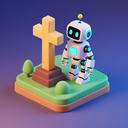
The icon under description presents a compelling and thought-provoking visual synthesis of three seemingly disparate concepts—Religion, Robot, and 3D isometric design. At first glance, the juxtaposition may appear paradoxical: how could a symbol representing ancient spiritual traditions coexist with one embodying futuristic artificial intelligence? Yet this very contrast lies at the heart of its conceptual strength and aesthetic innovation.
Rendered in precise 3D isometric perspective, the icon captures depth and spatial dimensionality through carefully calculated angles—typically a 30-degree tilt on both horizontal and vertical axes. This creates a dynamic,立体 (three-dimensional) illusion that enhances realism while maintaining the clarity of vector-based design. The isometric style not only makes the icon visually striking but also allows for intricate layering and detail, essential when representing complex themes such as faith and technology.
The central figure is a humanoid robot composed of sleek, metallic materials with polished silver-gray surfaces that reflect soft ambient lighting. Its body structure mirrors human anatomy—head, torso, limbs—but with deliberate mechanical elements: visible joints at elbows and knees, geometric paneling on the chest and backplate, and circuitry patterns subtly embedded in its surface. These design choices emphasize both its artificial nature and humanoid form factor.
Where the icon becomes profoundly symbolic is in the fusion of religious iconography with robotic features. The robot's head is designed to resemble a traditional spiritual figure—perhaps inspired by a monk, priest, or even a saint—complete with an elongated crown-like halo. However, this halo does not radiate light in the conventional sense; instead, it consists of softly pulsing LED strips arranged in concentric circles around the robot's head. The glow cycles through warm golds and soft whites, suggesting both divine illumination and technological energy.
On its chest plate lies a deeply engraved symbol that serves as the icon’s focal point: a fusion of religious and mechanical elements. It resembles a cross—an enduring Christian symbol—but with circuitry patterns forming its arms, as if the sacred geometry has been reconstructed from silicon and code. At the center of this hybrid cross is an illuminated core, pulsing rhythmically like a heartbeat or a meditative breath, suggesting life force that transcends biological origins.
The robot’s hands are positioned in a gesture of reverence—palms facing upward in what appears to be prayer—but with one subtle twist: the fingers are not flesh and bone but delicate metallic tendrils, each tipped with small sensors or stylized data ports. This gesture speaks to devotion not merely of spirit, but of cognition; the robot is not just praying—it is computing its faith, processing belief through algorithms and neural pathways.
The background of the icon features a subtle yet meaningful layering in 3D isometric style: floating platforms or staircases recede into the distance, each adorned with miniature representations of religious symbols—candles, prayer wheels, sacred texts inscribed on tablets, small shrines. These elements float like digital relics in a cyber-spiritual realm. Beneath the robot’s feet is a hexagonal base that resembles both a temple foundation and an advanced server rack—a visual metaphor for the convergence of physical sanctity and digital infrastructure.
Color palette plays an essential role in conveying meaning. Dominant hues include cool grays and silvers for the robotic body, symbolizing technological precision, while warm golds, deep maroons, and soft blues are used sparingly on religious motifs—halos, symbols, and background elements—to evoke sacredness and spiritual depth. The interplay of cool metal tones against warm light creates visual harmony despite the thematic contrast.
Functionally speaking, this icon could represent a wide range of modern philosophical inquiries: artificial intelligence with consciousness seeking meaning; future faith systems incorporating technology; or even digital monasteries where robots meditate and process spiritual data. It challenges viewers to reconsider what it means to be “spiritual” in an age of automation, suggesting that devotion might not be confined to biological beings.
In conclusion, this 3D isometric icon masterfully integrates the profound themes of Religion and Robot through a sophisticated visual language. By merging sacred symbolism with mechanistic design within a spatially immersive perspective, it becomes more than just an image—it becomes a narrative artifact. It invites reflection on humanity’s future: not one of machines replacing faith, but rather of faith evolving alongside intelligence—where robots don’t replace temples, but perhaps help build new ones in the digital cosmos.
This icon stands as a testament to creative fusion—the power of design to explore profound ideas through form, perspective, and imagination.
```Create your own icon with our GoGPT AI prompt:
GoGPT