

Religion Tree Retro Free icon download
Download all to grab every PNG variant.
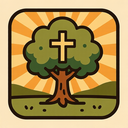
The icon in question is a meticulously crafted visual symbol that masterfully blends the profound spiritual essence of religion, the timeless symbolism of the tree, and a distinct, nostalgic aesthetic rooted deeply in retro design. Measuring approximately 64x64 pixels—ideal for use as an app icon, website favicon, or digital badge—the image is not merely a static representation but an evocative narrative that speaks across centuries and cultural boundaries.
At its core lies the figure of a towering, stylized tree whose trunk ascends vertically in bold, organic curves. The tree’s form recalls ancient mythologies where trees are seen as bridges between worlds—the axis mundi connecting heaven, earth, and the underworld. However, rather than depicting a naturalistic oak or pine, this tree is rendered with the angular simplicity and geometric stylization characteristic of mid-20th-century design—specifically reminiscent of 1960s and 1970s graphic art. Its limbs extend outward in symmetrical arcs, forming a crown that resembles both a halo and an open hand offering blessings, symbolizing spiritual nourishment and divine reach.
The trunk is divided into segmented sections using retro-inspired color blocking: deep forest green on the left side transitioning into warm ochre on the right, with sharp horizontal lines defining each segment. These divisions echo the visual language of early computer graphics and analog circuit boards—elements frequently associated with retro-futurism. The tree’s roots, however, are not buried in soil but emerge from a stylized geometric base composed of interlocking circles and concentric triangles—shapes commonly seen in vintage psychedelic posters and religious mandalas alike. This fusion suggests that the sacred tree is not just rooted in nature but also grounded in spiritual geometry, linking the physical with the metaphysical.
What truly distinguishes this icon is its integration of religious symbolism. At the center of the tree’s crown sits a small, glowing orb—reminiscent of a sun or spirit—rendered in radiant yellow and gold, slightly blurred to simulate light diffusion. This orb is subtly shaped like an eye, reminiscent of the "Eye of Providence" found in various religious traditions including Christianity (in depictions of God watching over humanity), Hinduism (as the third eye of Shiva), and ancient Mesopotamian art. Surrounding this central light are six smaller orbs arranged in a hexagram pattern, referencing both the Star of David and the Tree of Life from Kabbalistic tradition. These celestial points pulse faintly, creating an illusion of gentle animation when viewed on digital devices—a nod to retro pixel art’s limited but expressive motion capabilities.
Color choices are intentionally nostalgic. The palette is drawn from vintage 1970s design: muted earth tones combined with saturated primary hues—crimson red, cobalt blue, and mustard yellow. These colors are not randomly selected; they carry historical and spiritual weight. Crimson symbolizes sacrifice and divine love in many traditions; cobalt echoes the sacred blue of Hindu deities like Krishna or the Virgin Mary’s robes; mustard yellow is associated with enlightenment in Buddhist iconography. The use of these shades, combined with a slightly grainy texture overlay—similar to old film stock or faded poster paper—imbues the icon with a sense of age, authenticity, and enduring presence.
The retro aesthetic extends beyond color and shape into its rendering technique. The entire image is pixel-perfect in its execution, built from individual pixels arranged in a grid-like formation. This style harks back to early video games such as those on the Atari 2600 or Nintendo Entertainment System, where visual simplicity demanded symbolic clarity. Yet, unlike many retro icons that lean toward abstraction or mechanical design (such as a robot or spaceship), this one embraces organic forms with deliberate craftsmanship—proving that even in minimalist digital formats, profound meaning can be conveyed.
Furthermore, the icon includes subtle cultural echoes. In the lower right quadrant of the tree’s trunk, a small crescent moon is etched—symbolizing cyclical time and spiritual renewal in various traditions including Islam and paganism. To balance it, a tiny star is placed on the opposite side—an element frequently seen in Jewish ritual objects like menorahs or kabbalistic symbols. These details are so small they might be missed at first glance, but they invite closer inspection—a hallmark of retro design that rewards patience and attention.
In essence, this icon transcends mere visual representation. It is a modern artifact rooted in ancient wisdom, crafted through the lens of nostalgia and digital craftsmanship. The tree stands as both a symbol of life and spiritual growth, while the religion-infused elements suggest universal truths found across faiths. And the retro styling? It’s not just a trend—it’s a deliberate homage to an era when design was bold, meaningful, and deeply personal. Together, these three components converge into a single image that speaks not only to where we’ve come from but also to where we may yet journey—spiritually, symbolically, and digitally.
Create your own icon with our GoGPT AI prompt:
GoGPT