

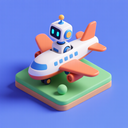
Robotics Airplane 3D isometric Free icon download
Download all to grab every PNG variant.
```html The icon in question is a meticulously crafted representation that masterfully merges the futuristic concepts of robotics, aviation, and advanced digital design. At its core, this icon embodies a harmonious fusion of technology and innovation through its distinctive 3D isometric perspective—a visual style renowned for providing depth and dimensionality while maintaining clarity and modern aesthetics. This particular icon stands out not merely as a graphic element but as an emblem of cutting-edge technological convergence, symbolizing the next frontier where autonomous systems take flight through intelligent engineering. The central subject of this icon is a sleek, aerodynamic airplane, rendered in a stylized yet highly realistic 3D isometric format. Its design reflects advanced aerospace engineering principles: smooth, streamlined contours minimize air resistance; the wings are slightly swept back with subtle winglets at the tips for enhanced lift efficiency. The body of the aircraft features angular edges and a futuristic matte finish with metallic gray hues accented by blue-tinted highlights, suggesting both durability and high-performance materials. Integrated into its frame are glowing indicators—soft cyan LED lights along the wing edges and nose tip—that pulse gently, evoking a sense of motion even when static. These subtle lighting elements reinforce the impression that this is not an ordinary plane but one imbued with artificial intelligence and autonomous operation. What truly elevates this icon beyond a standard aircraft rendering is its integration of robotics elements. The airplane's design seamlessly incorporates features characteristic of advanced robotic systems, transforming it into a hybrid machine: an autonomous aerial robot. At the nose, a cluster of sensor arrays—resembling multi-directional cameras and LiDAR units—protrude slightly from the fuselage, arranged symmetrically to enable 360-degree environmental perception. These sensors are rendered with precision in the isometric view, allowing viewers to perceive their spatial relationship within the aircraft's structure. Below them, a robotic gripper mechanism extends from the undercarriage—a retractable arm capable of grasping objects mid-air—suggesting applications in cargo delivery, aerial inspection, or search-and-rescue operations. The wings themselves are not mere static appendages but dynamic structures with articulated joints and micro-actuators embedded within their leading edges. These components are subtly illustrated through fine lines and textured shading that mimic robotic servos, indicating the plane’s ability to adjust its wing shape in real-time for optimal flight performance across varying atmospheric conditions. The propulsion system consists of dual electric ducted fans housed within the fuselage’s tail section, featuring rotating blades with transparent, crystalline-like materials—symbolizing energy efficiency and quiet operation typical of next-gen drones. In the 3D isometric projection, every component is rendered with careful attention to spatial relationships. The icon employs a consistent vanishing point approach that gives the illusion of depth without distorting proportions. This technique allows viewers to perceive both front and side aspects simultaneously—the aircraft’s profile, wing structure, and robotic appendages all visible in one glance. The use of layered shadows and gradient lighting enhances realism, making the plane appear as if it’s hovering mid-air within a digital space. Background elements—such as faint grid lines or a minimalist cityscape floating in the distance—are subtly included to suggest context without overwhelming the focal point. Color palette choices further emphasize technological sophistication. Dominant tones include cool grays and silvers, symbolizing engineering precision and modernity, while strategic highlights in electric blue represent connectivity, artificial intelligence, and energy flow. The contrast between dark base colors and luminous accents creates visual hierarchy—directing attention to critical features like sensor clusters, control surfaces, or robotic mechanisms. This careful color psychology reinforces the icon’s identity as a symbol of intelligent aerial robotics. The overall composition balances complexity with clarity. Despite its intricate details—robotic limbs, sensor arrays, articulated wings—the icon remains instantly recognizable and scalable for use across digital platforms. Whether displayed on a smartphone interface, embedded in an infographic about AI-driven aviation, or used as a logo for an aerospace robotics startup, this icon communicates innovation at first sight. In essence, this icon transcends mere representation. It encapsulates the future of transportation: autonomous aircraft designed with robotic intelligence to navigate complex environments safely and efficiently. Through its 3D isometric design, it offers depth and dimensionality that invite exploration—each line a narrative of engineering excellence; each glow a whisper of artificial consciousness. The integration of "robotics," "airplane," and "3D isometric" isn’t coincidental—it’s foundational. Together, these elements create a powerful visual metaphor for progress: machines that fly like birds but think like minds, soaring through both the skies and the digital frontier. ```
Create your own icon with our GoGPT AI prompt:
GoGPT