

Robotics Bicycle Outline Free icon download
Download all to grab every PNG variant.
```html
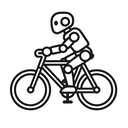
The icon under discussion is a meticulously crafted visual representation that seamlessly blends the futuristic concept of robotics with the timeless design of a bicycle, all rendered in a clean, minimalistic outline style. This fusion creates a powerful symbol representing innovation in sustainable transportation, where human-powered mobility meets advanced artificial intelligence and mechanical engineering. The design captures attention through its simplicity and depth—offering both immediate recognition and layered meaning.
At the core of this icon lies the bicycle—a universally recognized symbol of freedom, efficiency, and eco-conscious travel. The bicycle is depicted in a stylized yet highly accurate outline form, emphasizing its essential components: two wheels with distinct spoke patterns that suggest motion even when static; a curved handlebar that arcs gracefully upward; a smooth frame forming an angular triangle for structural balance; and pedals positioned at the bottom bracket. Each element is drawn with precision using thin, continuous lines—characteristic of the outline style—which gives the image a sense of lightness and modernity. The absence of fill colors or gradients ensures focus remains on form and function.
What elevates this icon beyond a mere representation of cycling is its integration with robotics—a theme that transforms the bicycle from a simple machine into an intelligent, adaptive system. Embedded within the frame, particularly near the center and around the front wheel hub, are subtle yet distinct robotic elements. These include sleek geometric shapes resembling sensors or micro-actuators—small squares, circles, and hexagons—positioned to suggest data collection and response mechanisms. The robot components are not superimposed but integrated into the bicycle's design as if they were naturally evolved parts of the vehicle’s structure, symbolizing a harmonious merger between human ingenuity and machine intelligence.
The outline technique enhances this integration by allowing transparency in visual hierarchy. The robotic features are drawn with the same thin stroke as the bicycle, ensuring they appear unified rather than tacked on. This subtle blending reinforces the idea that robotics is not an external addition but an intrinsic evolution of cycling technology. For instance, a small circular sensor near the front wheel may resemble a camera lens or LiDAR unit, while faint line patterns extending from the handlebars suggest data pathways—perhaps wireless connectivity or feedback loops between rider and machine.
Another striking feature is how motion and intention are implied through minimal lines. The bicycle’s wheels are drawn with slightly asymmetrical spokes on one side, suggesting forward momentum. A delicate arc extending from the rear wheel hints at a trail of energy or digital signal, reinforcing the notion that this isn’t just any bike—it’s an intelligent system actively processing information and responding to its environment. These details are rendered in such a way that they remain almost imperceptible upon first glance but become evident upon closer inspection, rewarding attention and curiosity.
The icon’s use of negative space is equally significant. The open areas within the outline—such as the gaps between spokes or around the seat tube—are not wasted but are used purposefully to guide the eye and create balance. This restraint in design reflects core principles of both robotics engineering (efficiency, minimalism) and sustainable transportation (reducing material use while maximizing function). The clean lines also ensure scalability—the icon remains legible and effective whether displayed on a smartphone screen or projected on a large digital billboard.
From a conceptual standpoint, this icon serves as a visual manifesto for the future of urban mobility. It speaks to the convergence of human effort and machine assistance: where riding becomes enhanced by intelligent systems—auto-balancing, adaptive gear shifting, route optimization, collision avoidance—all powered by embedded robotics. Yet it retains the fundamental charm of bicycles: simplicity, accessibility, and personal freedom.
Finally, the outline style contributes to its universal appeal. Without relying on color or complex textures, the icon transcends cultural and linguistic barriers. Whether viewed in a tech conference brochure in Tokyo or a sustainability report in Berlin, its message remains clear—innovation doesn’t have to abandon tradition. In fact, it can elevate it.
In summary, this icon masterfully combines three distinct elements—Robotics, Bicycle, and Outline—not merely as separate features but as interconnected principles of design and meaning. It is a symbol of progress that honors the past while boldly embracing the future: a smart bicycle in an elegant outline form, where every line tells a story of integration, intelligence, and sustainable motion.
```Create your own icon with our GoGPT AI prompt:
GoGPT