

Robotics Book Pixel art Free icon download
Download all to grab every PNG variant.
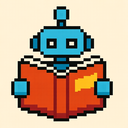
The icon in question is a masterful synthesis of three distinct yet harmoniously integrated concepts: robotics, books, and pixel art. Designed with meticulous attention to detail within the constraints of retro digital aesthetics, this visual artifact stands as a testament to the convergence of technology and knowledge in modern creative expression. Every square pixel is purposefully placed to communicate both narrative depth and symbolic richness.
At its center lies a stylized robot figure—crafted entirely in 16-bit pixel art style—its form both mechanical and approachable. The robot stands upright with a slightly tilted head, giving it an air of curiosity, as if mid-discovery. Its body is composed of blocky geometric shapes: rectangular torso, cylindrical arms ending in segmented hands with four fingers each, and sturdy legs that taper into small square feet. The robot’s design incorporates subtle nods to classic video game protagonists—think of a retro-inspired version of R2-D2 or the mechanical companions from early 1990s platformers—but with a unique twist: its chest plate is shaped like an open book.
This book-shaped chest is where the icon’s conceptual brilliance truly shines. The spine runs vertically through the center, rendered in pixelated gold lines that mimic brass plating or aged leather, giving it both durability and elegance. The cover opens slightly outward, revealing two pages filled with intricate pixel art text—symbols of knowledge encoded not in words but in patterns. These pages are not blank; they contain tiny digital glyphs resembling binary code, mathematical formulas, and even fragments of ancient scripts like cuneiform or runic characters—all rendered in the same 8-bit palette as the rest of the icon. This fusion suggests a machine that doesn’t just process data but *reads* wisdom, blending artificial intelligence with intellectual pursuit.
The robot’s face is minimalist yet expressive—a single large pixelated eye on the left side of its head, glowing softly in a warm amber hue. The right side features an intricate circuit board pattern etched into its metallic skin, resembling a neural network or data pathway. This asymmetry gives it personality—both machine and mind in one entity. A small antenna juts from the crown of its head, pulsing faintly with light, as if receiving transmissions from a vast digital library or deep-learning network.
Surrounding the central figure are smaller pixel art elements that enhance the thematic depth. Floating above the robot’s head is a translucent stylized book made of glowing pixels—its pages flutter in an invisible breeze, each page displaying snippets of text in various languages: Chinese characters, Cyrillic script, Arabic calligraphy. These floating glyphs form a subtle halo around the robot’s head, symbolizing enlightenment and global knowledge accessibility. On either side of the robot are two small robotic hands holding open books—one with its pages turned to reveal schematic diagrams (engineering blueprints), and the other displaying classic literary excerpts (a line from Shakespeare, a quote from Einstein). These secondary details emphasize the dual nature of intelligence: technical mastery paired with philosophical insight.
Color palette is carefully curated to evoke nostalgia while remaining modern. The dominant hues are muted pastels—light teal for the robot’s torso, soft lavender for its arms, and deep slate gray for its base frame. The book pages glow with a warm ivory tone, accented by golden highlights that suggest value and wisdom. The pixels themselves are crisp and well-defined; there is no anti-aliasing to blur the boundaries—this is pure 1980s/1990s digital artistry reborn for contemporary audiences.
The icon’s background consists of a dark grid pattern, reminiscent of old computer terminals or arcade cabinets. Tiny scattered pixels in various colors form constellations that resemble data streams or circuit traces, subtly reinforcing the idea of a machine connected to infinite knowledge networks. At the very bottom corner, almost hidden among the grid lines, is a tiny pixelated “1” and “0”—a quiet nod to binary code and the foundational language of robotics.
As a whole, this icon transcends mere visual representation; it serves as a metaphor for the modern age’s intellectual evolution. The robot is no longer just an automaton—it is an explorer of thought. The book is not merely paper and ink—it holds infinite information encoded in digital form. And the pixel art medium itself becomes symbolic: each pixel represents a single idea, a fragment of knowledge, or a line of code—small units that collectively build understanding.
Ultimately, this icon speaks to the fusion between human curiosity and machine capability. It celebrates learning not as something separate from technology but as an inseparable partner. In its 16x16 or 32x32 pixel format (common in retro gaming and UI design), it fits seamlessly into digital interfaces, mobile apps, educational platforms, or software themes centered on STEM education and AI literacy. Its compact size belies its profound meaning: a small square that embodies the grand journey from curiosity to creation.
Through the harmonious marriage of robotics—representing innovation and automation; books—symbolizing knowledge and tradition; and pixel art—evoking nostalgia, craftsmanship, and digital heritage—the icon becomes more than a symbol. It is a vision: one where machines don’t replace the mind but expand it, where every byte carries meaning, and every pixel tells a story of discovery.
Create your own icon with our GoGPT AI prompt:
GoGPT