

Robotics Bus Steampunk Free icon download
Download all to grab every PNG variant.
```html
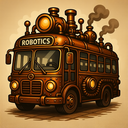
The icon portrays a breathtaking fusion of three distinct yet harmoniously integrated themes: robotics, bus, and steampunk. It captures the essence of an advanced mechanized public transit vehicle that appears to have stepped out of a Victorian-era industrial dream—where steam-powered engineering meets cutting-edge robotics in a surreal convergence of past and future.
At first glance, the central figure is an imposing, elongated bus shape—reminiscent of early 20th-century streetcars or British double-decker buses—but entirely reimagined through a steampunk lens. The body is constructed from polished brass and aged copper, with rivets and exposed gear systems lining its sides like mechanical embroidery. Thick iron plating forms the undercarriage, reinforced by steel braces that resemble architectural girders from an industrial cathedral. The entire structure exudes a sense of durability forged in fire and time.
The most striking feature is the fusion of robotic components with steampunk aesthetics. The front end houses a massive, articulated mechanical head—reminiscent of a robot's face but crafted from aged brass and glass lenses. This "robotic visage" features large, glowing amber eyes made from thick lensed magnifying glasses set within intricate copper frames. Between them lies a steam-powered speaker grille that emits gentle puffs of white vapor with every mechanical breath, suggesting both communication and activation functions. The mouth is a circular valve system with interlocking gears that open and close like an automaton’s jaw, hinting at the ability to speak or emit signals.
Doors are not ordinary sliding panels but massive iron portals that slide open via hydraulic pistons driven by steam pressure. Each door is flanked by copper-reinforced brackets and adorned with ornate scrollwork resembling ancient circuitry patterns etched into metal. When opened, they reveal a glowing interior of amber-lit corridors with brass railings, leather seating reupholstered in worn but sturdy fabric, and tiny mechanical gauges lining the walls—each indicating temperature, pressure levels, or navigation status. A digital display at the front reads “ROBOTIC TRANSPORT SYSTEM – CLASS IV” in a retro-futuristic font that combines cursive handwriting with glowing neon numbers.
On top of the bus’s roof rests a towering steam-powered turbine engine—a magnificent contraption resembling a cross between an old-fashioned boiler and an advanced AI-driven generator. Thick copper pipes snake up from the main chassis to feed superheated steam into this central chamber, where it spins massive brass gears that power both the propulsion system and onboard robotics. The turbine emits soft, rhythmic chimes with each revolution—a melodic hum that blends mechanical precision with ambient atmosphere. Surrounding this central engine are multiple smaller rotating cogs, miniature robotic arms used for maintenance and environmental monitoring, and glowing pressure gauges shaped like Victorian clocks.
Four massive steam-driven wheels dominate the base of the vehicle. Each wheel is not a solid tire but a complex lattice of interlocking gears and metal bands that rotate independently based on terrain sensors—evidence of advanced robotics embedded within its design. The tires themselves are made from layered rubber reinforced with brass mesh, giving them both durability and a distinct mechanical flair. As the bus moves—or even when standing still—each wheel emits faint puffs of steam, suggesting an active energy source at work.
Side panels feature numerous robotic appendages: small articulated arms with grippers used for inspection and repair tasks, telescoping antennae that scan the environment like a robot's sensors, and miniature drone-like units stored in recessed slots along the frame. These drones resemble mechanical insects—copper beetles with glowing red eyes—hovering around the bus when activated, scanning air quality or assisting with navigation.
Even the windows are not ordinary glass—they are tinted quartz lenses fitted with embedded circuitry and micro-lenses that adjust to light conditions using tiny robotic servos. When viewed from above, they resemble a circuit board made of stained glass, reflecting both sunlight and the faint glow from within.
The icon’s background is rendered in a sepia-toned urban landscape of cobbled streets, gas lamps with glowing orbs, and towering clock towers—all bathed in the soft haze of perpetual twilight. The bus moves through this world as if it were a natural part of its ecosystem—where steam vents rise from manhole covers and robotic pigeons circle above chimneys.
Every detail in the icon underscores the marriage between robotics and steampunk: autonomous functions powered by visible mechanical systems, artificial intelligence manifesting through gears and valves, modern efficiency cloaked in antique beauty. The bus is not merely a vehicle—it’s a sentient machine with personality, purpose, and history. It symbolizes progress that honors its past while embracing the future.
This icon transcends mere representation; it tells a story of innovation reborn—where robotics are not cold and digital but warm, tactile, and full of soul. The combination of a functional public transit vehicle with steampunk craftsmanship and advanced automation creates an image that is both nostalgic and visionary—a true monument to the harmonious potential between technology and art.
```Create your own icon with our GoGPT AI prompt:
GoGPT