

Robotics Drone Pixel art Free icon download
Download all to grab every PNG variant.
```html
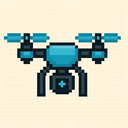
The icon in question is a meticulously crafted digital artwork that masterfully merges the futuristic themes of robotics and drone technology with the nostalgic charm and deliberate simplicity of pixel art. Measuring precisely 64x64 pixels—a standard size in classic video games and retro-inspired design—the icon is a miniature masterpiece that captures the essence of modern technological advancement through a vintage lens.
At its core, this icon represents an autonomous robotic drone—symbolizing the convergence of artificial intelligence, mechanical precision, and aerial mobility. The central figure is a compact hexacopter drone with six symmetrical rotors arranged in a circular pattern around its core chassis. Each rotor is represented by four distinct pixels: two for the rotating arm and two for the propeller blade, creating a dynamic sense of motion even in static form. This pixel-perfect detailing ensures that the mechanical nature of the drone is immediately recognizable, despite being rendered at such a small scale.
The drone’s body is constructed from sharp, geometric shapes composed entirely of colored pixels. The chassis appears to be made of brushed metal, achieved through a carefully curated palette: light gray (#B0B0B0) for the main structure, with darker steel hues (#4A4A4A) used for structural joints and seams. A faint blue glow emanates from the center where the drone’s core processor is located—a subtle but critical detail that signifies intelligence and autonomy. This core glows with a soft cyan hue (#00FFFF), its intensity modulated across two pixels to give a pulsating, alive appearance, suggesting real-time data processing and responsive AI.
What sets this icon apart from typical drone depictions is its integration of robotics aesthetics. Instead of the typical sleek plastic or carbon-fiber designs seen in modern consumer drones, this one exhibits mechanical joints, exposed gears (rendered as tiny concentric circles made of three pixel layers), and segmented limbs that suggest robotic articulation. One can see a small manipulator arm extending from the front left side—a clear nod to robotics functionality beyond mere flight. This arm is composed of three jointed segments, each defined by contrasting pixel colors: dark gray for the base, medium gray for the hinge, and light silver for the end-effector (a small claw or gripper made of four pixels). This detail transforms the drone from a simple flying device into a multi-functional robotic platform capable of interacting with its environment.
Pixel art techniques are not just applied to aesthetics but serve as structural foundations. Every line is carefully placed, adhering to strict 1:1 pixel alignment. The icon uses dithering in certain areas—such as the transition from the drone’s body to the surrounding air—to simulate depth and texture without introducing blur or anti-aliasing, which would compromise its retro authenticity. The color palette is limited to just 8 colors, a hallmark of classic 8-bit games: black (#000000), dark gray (#2A2A2A), medium gray (#7F7F7F), light gray (#BFBFBF), bright white (#FFFFFF), deep blue (#1E4D9C), electric cyan (#3ED3FF) and matte silver (a gradient from #CCCCCC to #E0E0E0). This restraint enhances visual clarity and reinforces the pixel art identity, making the icon instantly recognizable as a piece of digital retro craftsmanship.
Background elements are minimal but intentional. A faint grid pattern in dark gray (#3C3C3C) underlies the icon, subtly referencing early video game environments and reinforcing its pixel-based origins. The drone floats slightly above this grid, with two pixels of transparent space beneath it—suggesting levitation or flight without physical contact. This detail is crucial: it visually communicates that the object is airborne and self-propelled, a hallmark of both drones and advanced robotics.
The icon’s composition balances symmetry and function. The six rotors are evenly spaced at 60-degree intervals, creating perfect radial symmetry—an aesthetic choice that conveys mechanical precision. However, small asymmetries in the pixel arrangement (such as a slightly offset propeller blade on the front-right rotor) break perfect predictability in a way that suggests organic motion rather than robotic rigidity. This intentional imperfection adds character and life to an otherwise machine-like design.
In summary, this icon is more than just a visual representation—it’s a narrative capsule. It speaks to the future of robotics where machines are not only intelligent but also mobile, interactive, and versatile. It embodies the spirit of innovation found in modern drones while celebrating the creative constraints and artistic integrity of pixel art. Every pixel tells a story: of flight, intelligence, mechanical precision, and digital nostalgia—all synthesized into a 64x64 canvas that stands as a testament to how technology and art can coexist beautifully.
```Create your own icon with our GoGPT AI prompt:
GoGPT