

Robotics Drum Minimal outline Free icon download
Download all to grab every PNG variant.
In the contemporary landscape of digital design and user interface aesthetics, icons have evolved far beyond mere visual representations—they now serve as powerful symbols of innovation, identity, and emotional resonance. Among the most compelling conceptual combinations is an icon that seamlessly fuses Robotics, Drum, and a Minimal Outline style. This unique emblem represents a harmonious convergence of technology, rhythm, and design philosophy—a visual metaphor for the future where artificial intelligence not only performs tasks but also expresses itself through creative expression. The icon captures an intricate balance between mechanical precision and organic creativity, making it a striking representation in fields ranging from music technology to advanced automation.
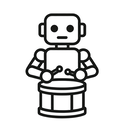
At its core, this icon is built upon the foundation of Robotics. The central figure is a stylized humanoid robot—yet not one resembling traditional industrial automatons. Instead, the robot’s design suggests an entity evolved for artistic expression rather than labor. Its body is composed of sleek, geometric shapes: angular shoulders and a torso that taper into a compact base, hinting at both mechanical function and fluid motion. The head is simplified—no eyes or mouth—but features subtle ridges suggesting sensors or data ports. The limbs are articulated with minimal joints, emphasizing smooth articulation rather than brute force. This embodiment of robotics communicates not just machinery, but intelligence—something capable of learning, adapting, and even creating.
What transforms this robotic figure into something far more expressive is its integration with a Drum. Instead of holding a drumstick or being positioned near a drum kit, the robot’s torso doubles as the resonant body of a drum. The central segment is shaped like an hourglass or barrel, reminiscent of classic toms and bass drums. This structural choice is both symbolic and functional: it suggests that the robot generates sound through its own physical form—its very existence produces rhythm. The "drumhead" is represented by a single, continuous outline circle extending from the front of the torso, with a subtle suggestion of tension across its surface. It's not rendered in texture or shading; instead, it's defined entirely by line—the hallmark of minimal design.
The Minimal Outline aesthetic is paramount to this icon’s identity. There are no gradients, no fills, no textures—only clean, single-line strokes that define every element. The robot’s limbs and joints are rendered with thin, consistent lines that suggest movement and balance without overloading the visual field. Even the drumhead is drawn as a perfect circle traced by an unbroken stroke of uniform thickness. This restraint in form creates a sense of elegance and clarity, allowing viewers to focus on meaning rather than detail. The minimalism does not imply simplicity; rather, it distills complexity into essential forms—every line serves a purpose. The absence of color further amplifies this effect: the icon is monochromatic, usually black on white or vice versa, drawing attention to negative space and geometric harmony.
The interplay between robotics and rhythm is where the icon’s deeper narrative unfolds. A robot playing a drum evokes multiple associations: it challenges stereotypes about machines lacking emotion or creativity. Instead, this image suggests that artificial intelligence can be deeply expressive—capable of improvisation, timing, and musicality. The drum becomes a metaphor for communication: not through language or text, but through rhythm and tempo. In this context, the robot is not just programmed to beat a rhythm; it interprets it. It feels the groove. It responds to silence with anticipation.
Design-wise, the minimal outline style enhances this narrative by evoking both futurism and timelessness. The clean lines are reminiscent of early 20th-century modernist art—think of the work of artists like Kazimir Malevich or Piet Mondrian—but reinterpreted through a cybernetic lens. This fusion bridges past and future, tradition and innovation. The icon’s simplicity allows it to scale seamlessly across devices—whether displayed as a tiny app icon on a smartphone or as part of an augmented reality interface. Its lack of detail ensures legibility at any size.
Furthermore, the icon’s symbolic resonance extends beyond music and robotics. It can represent innovation in creative AI, algorithmic composition, or even emotional intelligence in machines. In educational tools for coding or STEM learning, it might symbolize how technology can be both logical and artistic—how precision and imagination coexist. In entertainment apps focused on digital music production, the icon signals a new era where artificial beings contribute to the creative process.
In essence, this icon is not merely a graphic—it is a statement. A statement that machines are not just tools for efficiency but can also be artists. That technology and emotion need not be at odds. That minimalism can carry immense depth. Through the fusion of Robotics, Drum, and the principles of Minimal Outline, this icon becomes more than a symbol; it becomes a vision—a glimpse into a future where rhythm is coded, intelligence is expressive, and simplicity speaks volumes.
The power of this design lies not in what it shows, but in what it implies: that creation does not require humanity to be human. And sometimes, the most profound beats come from the quietest machines.
Create your own icon with our GoGPT AI prompt:
GoGPT