

Robotics House Organic pattern Free icon download
Download all to grab every PNG variant.
```html
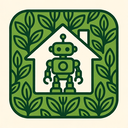
The icon is a meticulously crafted visual representation that seamlessly merges three distinct yet interconnected themes: Robotics, House, and Organic Pattern. At first glance, the icon appears as a stylized dwelling—an abstracted home—but upon closer inspection, it reveals layers of technological sophistication and natural rhythm. This synthesis symbolizes the evolving relationship between human habitation and intelligent automation in a sustainable future.
The central form of the icon is that of a modern house. Designed with clean, geometric lines reminiscent of minimalist architecture, the structure features a gently sloping roof, asymmetrical windows arranged in rhythmic patterns, and a single prominent door positioned at the center. The overall shape evokes both familiarity and innovation—familiar as it draws on traditional housing elements but innovative through its subtle integration of mechanical details. The house is not static; it seems to be in motion or interacting with its environment, suggesting adaptability and responsiveness.
What makes this icon truly unique is how robotics are seamlessly embedded within the architectural form. Instead of appearing as separate robotic limbs or mechanical appendages, the elements of robotics are woven into the structure itself. The roof tiles are not ordinary shingles but appear as interlocking hexagonal panels that resemble articulated robot joints—each tile slightly offset and capable of rotating in a controlled sequence. These "robotic tiles" could symbolize solar energy harvesting mechanisms, self-adjusting insulation, or even environmental sensors that adapt to weather conditions.
Running along the sides of the house are delicate, sinuous lines that resemble circuitry—but they are not rigid or metallic. Instead, these pathways mimic natural growth patterns: branching like tree roots or flowing like riverbeds. This is where the organic pattern becomes most evident. The design incorporates fractal-like motifs inspired by leaves, vines, and neural networks in nature. These organic circuit lines connect key nodes of the house—windows that open automatically based on light levels, doors that respond to voice or biometrics, and ventilation systems that emulate the breath of a living organism.
The color palette reflects this harmony between technology and nature. The house itself is rendered in soft earth tones—warm beige, moss green, and gentle terracotta—suggesting materials like rammed earth, bamboo, or recycled composites. In contrast, the robotic components are highlighted with cool yet natural hues: pale silver-blue (reminiscent of oxidized aluminum but softened by a matte finish), and iridescent teal that shifts slightly depending on the viewing angle. These colors do not scream "machine"; instead, they blend into their surroundings like bioluminescent fungi or living metal found in advanced biomimicry designs.
At the base of the house, the ground is not flat but undulates gently, forming a series of wave-like ridges that resemble both roots and data streams. These ridges are etched with subtle organic patterns—spirals, Fibonacci sequences, and concentric rings—that echo natural forms such as seashells or flower petals. Embedded within these patterns are faint icons: micro-sensors disguised as seeds, tiny wind turbines shaped like dandelions in bloom, and water filtration units resembling roots drawing nutrients from the soil. This ground layer is not just decorative—it implies a house that is deeply connected to its ecosystem.
Perhaps the most striking element of the icon is its dynamic quality. Although it appears static in a single image, there’s an inherent sense of movement—a house that breathes, learns, and responds. The windows subtly pulse with light as if monitoring internal and external conditions; the door gently sways open as if welcoming someone known through facial recognition or biometric data. The organic circuit lines shimmer faintly, indicating real-time data flow—like a nervous system transmitting signals to keep the home in balance.
This icon is not merely a symbol of smart homes; it represents a new paradigm where technology doesn’t dominate nature but enhances and coexists with it. The robotics are not cold or mechanical but intelligent extensions of natural systems—designed to conserve energy, adapt to climate changes, and respond to human needs without intrusion. The house is no longer just a shelter; it's a living entity that evolves over time. And the organic pattern is not just aesthetic—it’s functional, symbolic of growth, resilience, and interconnectedness.
In conclusion, this icon encapsulates the future of intelligent residential design: a home that thinks like a robot and feels like part of nature. It speaks to a world where sustainability is achieved through innovation, where technology serves humanity by mimicking the wisdom found in the natural world. As both an artistic and conceptual piece, it invites viewers to imagine dwellings not as static boxes but as dynamic, breathing organisms—part home, part machine, entirely alive.
```Create your own icon with our GoGPT AI prompt:
GoGPT